


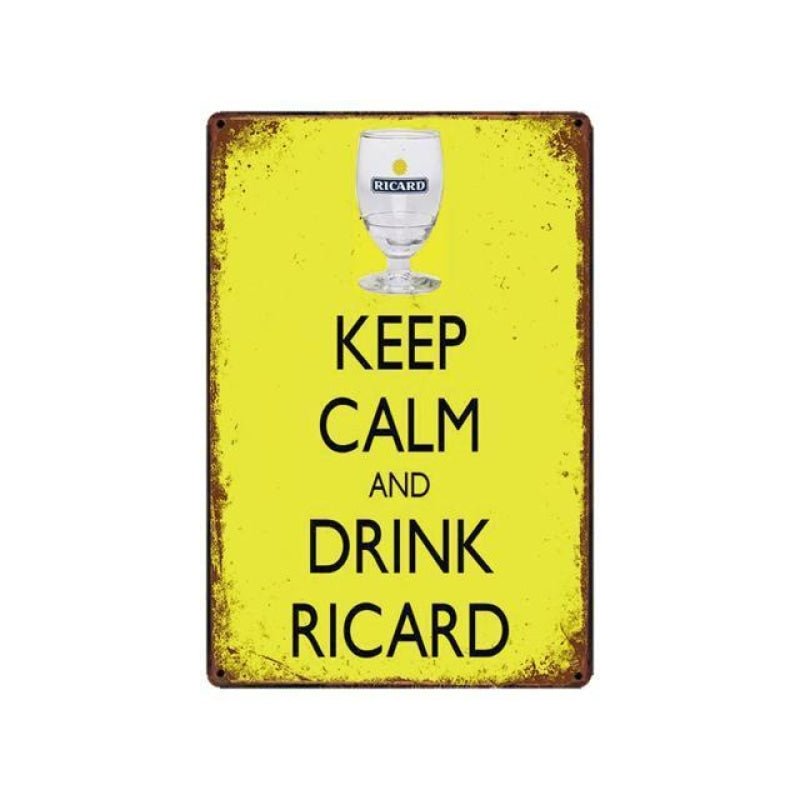




“Keep Calm And Drink Ricard” proclaims this splendid Vintage Metal Sign which will be ideal for your kitchen or a bar!
- ⚡ WITH THE PURCHASE OF TWO VINTAGE METAL PLAQUES, THE 3RD IS FREE! ⚡
- Materials:
- Metal protected against corrosion, built to last.
- Very light and easy to install.
- Packaged carefully and placed in a shock-resistant package for safe transport.
- Size: 20 (W) × 30 (L) cm / 30 (W) × 40 (L) cm.
- FREE SECURE DELIVERY & SHIPPED WITHIN 48/72 HOURS (see our FAQs).
Description of this Vintage Kawasaki Plate
Kawasaki Heavy Industries Ltd. (KHI) (川崎重工業株式会社, Kawasaki Jūkōgyō Kabushiki-gaisha) is a Japanese public multinational corporation primarily known as a manufacturer of motorcycles, engines, heavy equipment, aerospace and defense equipment, rolling stock, and ships. It is also active in the production of industrial robots, gas turbines, pumps, boilers, and other industrial products. The company is named after its founder, Shōzō Kawasaki, and has dual headquarters in Chūō, Kobe, and Minato, Tokyo.
KHI is known as one of Japan’s Big Three heavy industry manufacturers, alongside Mitsubishi Heavy Industries and IHI. Before World War II, KHI was part of the Kobe Kawasaki zaibatsu, which included Kawasaki Steel and Kawasaki Kisen. After the conflict, KHI became part of the DKB group (keiretsu).
The History of Kawasaki
Shozo Kawasaki, born in 1836, was involved in the maritime industry from a young age. He was involved in two disasters at sea but attributed his survival to ship modernization. Thus, he decided to create technological innovations for the Japanese maritime industry. In 1878, after struggling to find business, his first order was placed. This marked the beginning of the company’s operations.
In 1886, Kawasaki moved his business from Tokyo to Hyogo. This made room for the increased orders placed with his company and the name change to Kawasaki Dockyard. The new and improved company went public as Kawasaki Dockyard Co. Ltd. when demand for ships increased during the Sino-Japanese War of 1894. Kojiro Matsukata was announced as the company’s first president.
After opening a new factory in 1906, Kawasaki began to diversify its products. It began producing parts for the railway, automobile, and aircraft industries at the end of World War I. After the war, with the Allied arms limitation agreement of 1912, Kawasaki faced a huge decline in shipbuilding. In 1929, the Depression caused a number of financial problems for the company.
At the end of 1947, the government introduced a new shipbuilding program that allowed Kawasaki to increase its profits and restore the company. The company was able to resume all operations, and by the 1950s, Japan was the world’s largest shipbuilder.
In the late 1960s and 1970s, Kawasaki began to withdraw from the shipbuilding industry and diversified its business, producing motorcycles, jet skis, bridges, tunnel boring machines, and airplanes. It also supplied technologically advanced railway cars to the New York City subway system.
In 1995, Kawasaki Heavy Industries entered into an agreement with China to produce the largest container ships known to man. This led the company to announce higher-than-expected profits in 1996. However, shortly after these profits, the company experienced a long decline in business, forcing it to find a solution.
With the company seeing continued losses in the 21st century, it formed a joint venture with Ishikawajima-Harima Heavy Industries Co. However, at the end of 2001, the agreement was terminated. In the following years, Kawasaki Heavy Industries Co. experienced fluctuating profits and losses.