




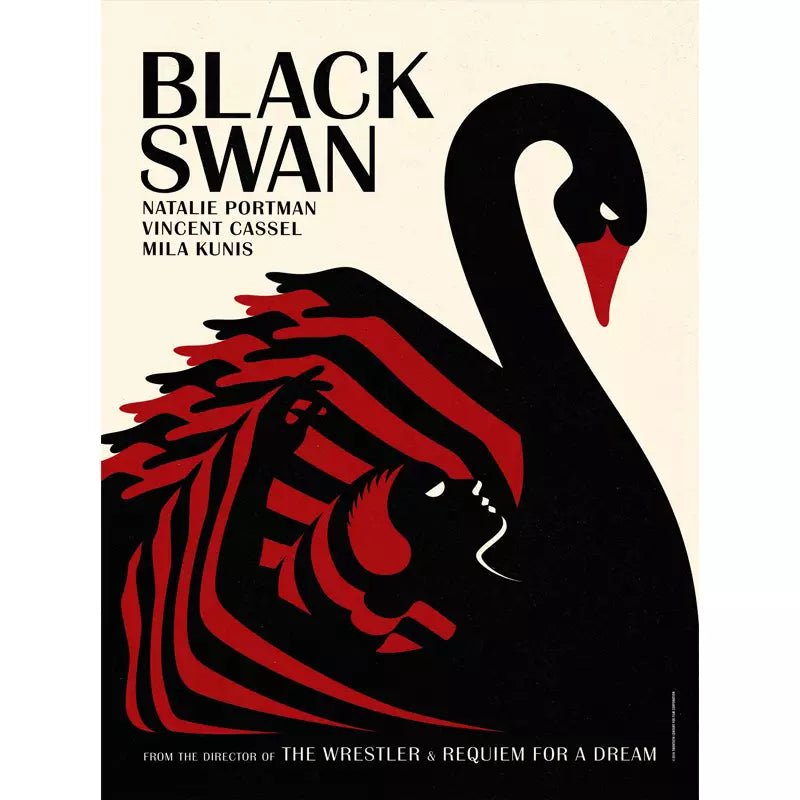





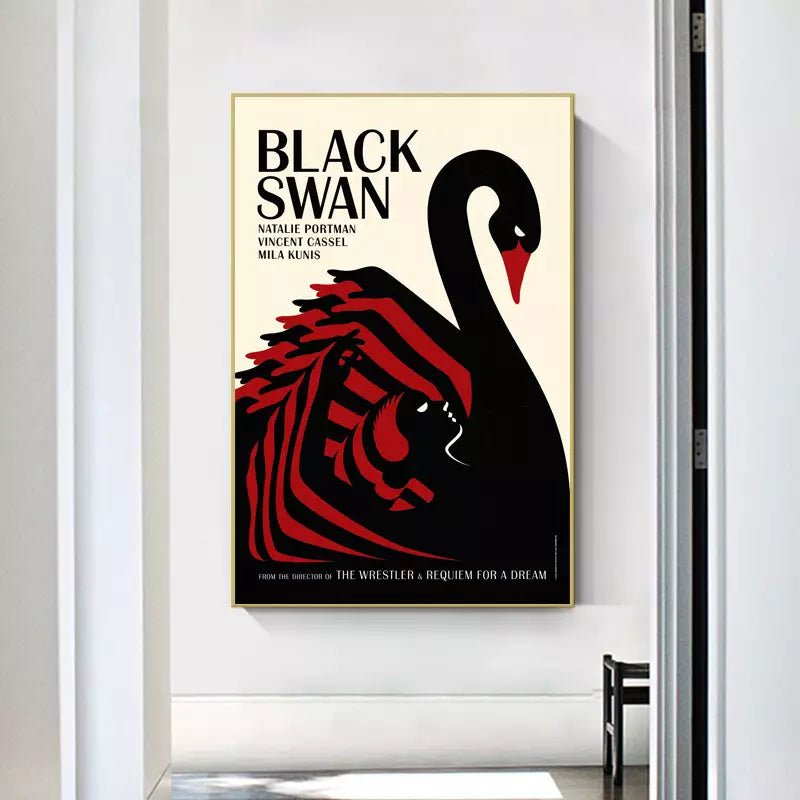


























Discover the Black Swan Poster and immerse yourself in a cinematic experience filled with intense emotions. This poster perfectly evokes the dark and captivating world of the film, depicting a lone dancer amidst an ocean of shadows. The palpable tension between grace and madness shines through in every detail, capturing the very essence of this acclaimed cinematic masterpiece.
- Paper Feature:
- 🎨 Canvas: Global standard in printing and imitating a “painting canvas” look.
- By default, the poster contains a 4cm white border for framing (frame not included). If you don’t want it, please choose “without white border”.
- ✅ Size: several choices available. ✅
- High UV resistance.
- Maximum color brilliance without reflections.
- Recycled paper guaranteed environmental friendliness.
- Poster wrapped carefully and delivered in a protective tube for total protection.
- FREE STANDARD DELIVERY.
⚠️ Frame not included. ⚠️
Description of this Black Swan Poster
Black Swan is a 2010 American psychological horror film directed by Darren Aronofsky from a screenplay by Mark Heyman, John McLaughlin, and Andres Heinz, based on a story by Heinz. The film stars Natalie Portman in the title role, with Vincent Cassel, Mila Kunis, Barbara Hershey, and Winona Ryder in supporting roles. The plot revolves around a production of Tchaikovsky’s Swan Lake by the New York City Ballet company. The production requires a ballerina to play the innocent and fragile White Swan, for which hired dancer Nina Sayers (Portman) is perfect, as well as the dark and sensual Black Swan, qualities best embodied by new rival Lily (Kunis). Nina is overcome by a sense of immense pressure when she finds herself competing for the role, causing her to lose her tenuous grip on reality and descend into madness.
Aronofsky conceived the script by linking his viewings of a production of Swan Lake to an unrealized screenplay about stunt doubles and the notion of being haunted by a double, as in the folklore surrounding doppelgängers. Aronofsky cites Fyodor Dostoevsky’s The Double as another inspiration for the film. The director also considered Black Swan a companion piece to his 2008 film The Wrestler, as both films revolved around performances demanding different kinds of art. He first discussed the project with Portman in 2000, and after a brief collaboration with Universal Pictures, Black Swan was produced in New York in 2009 by Fox Searchlight Pictures. Portman and Kunis trained in ballet for several months before filming.
Black Swan premiered at the 67th Venice International Film Festival on September 1, 2010, and received a limited release in the United States beginning on December 3, before going into wide release on December 17. Upon its release, the film received widespread critical acclaim, particularly for Aronofsky’s direction and the performances of Portman and Kunis. The film was also a major commercial success, grossing $329 million worldwide on a budget of $13 million. The film received five nominations at the 83rd Academy Awards, including Best Picture, with Portman winning Best Actress; it also received four nominations at the 68th Golden Globe Awards, including Best Motion Picture – Drama, with Portman winning Best Actress – Drama. In 2021, Portman’s performance was included in The New Yorker’s list of the best film performances of the 21st century.
Nina Sayers, a young dancer in the New York City Ballet company, lives with her overprotective mother, Erica, herself a former ballerina. The company opens the season with Tchaikovsky’s Swan Lake. After forcing principal dancer Elizabeth “Beth” MacIntyre to retire, artistic director Thomas Leroy announces that he is looking for a new dancer for the dual roles of Odette, the innocent and fragile white swan, and Odile, the sensual and dark black swan. Nina auditions for the roles and gives impeccable dancing as Odette, but fails to portray Odile.
The next day, Nina asks Thomas to reconsider the role. When he forcibly kisses her, she bites him and runs out of his office. Later that day, Nina reads the cast list and is surprised to discover that she has landed the lead role. At a gala celebrating the new season, a drunken Beth accuses Nina of performing for Thomas in exchange for a promotion. The next day, Nina learns that Beth has been hit by a car, but Thomas believes she attempted suicide. Nina visits an unconscious Beth in the hospital and is horrified to see that her legs have been severely injured, meaning Beth will no longer be able to perform as a dancer.
During rehearsals, Thomas tells Nina to observe a newcomer, Lily, who bears a physical resemblance to Nina but also an uninhibited quality that Nina lacks. Nina experiences hallucinations and finds scratch marks on her back.
One night, despite Erica’s objection, Nina accepts Lily’s invitation to go out for a drink. Lily offers Nina an ecstasy capsule, telling her it will help her relax. Nina initially refuses, then accepts. She tells Lily that the effects will only last a few hours and quickly begins acting under the influence of ecstasy. Nina flirts with the men at the bar and with Lily. They dance at a nightclub and return to Nina’s apartment late that night. After arguing with Erica, Nina barricades herself in her room, and Lily performs oral sex on her. The next morning, she wakes up alone and realizes she is late for the dress rehearsal. Arriving at Lincoln Center, Nina sees Lily dancing as Odile and confronts her about their night together. Lily seems troubled by Nina’s insinuation that they slept together and denies going home with Nina, saying she went home with one of the men from the bar. Nina is convinced that Lily intends to take her place, especially after learning that Thomas has made Lily his replacement. Nina’s hallucinations become more intense and her injuries more numerous, even imagining herself transforming into Odile. On opening night, Nina criticizes her mother for calling the theater to tell them she was unfit to perform, fearing the role would be too difficult for her. When Nina arrives late, Lily is ready to replace her, but Nina convinces Thomas to allow her to reprise her role.
Toward the end of the ballet’s second act, Nina is distracted by another hallucination and loses her stability as Odette. The dancer playing the prince drops her onstage, angering Thomas. She returns to her dressing room and finds Lily there preparing to perform the role of Odile. During a confrontation, Lily transforms into Nina. The two fight and break a mirror. Nina stabs her doppelganger with a large shard of glass from the mirror, killing her. The body reverts to Lily’s. Nina hides the corpse in the bathroom and takes the stage, dancing perfectly as Odile and seemingly transforming into a black swan, her arms covered in feathers. To a standing ovation from the audience, Nina surprises Thomas with a passionate kiss and returns to her dressing room.
As Nina changes back into Odette’s tutu and white swan makeup, she hears a knock at her door. She opens it to find Lily alive, who apologizes for the misunderstanding and congratulates Nina before taking her leave. Confused, Nina finds that the mirror is still broken and the towel she used to mop up the blood is clean, with no corpse in the bathroom. She looks down and removes a piece of glass from her abdomen, realizing that she stabbed herself, not Lily.
Nina dances the final act of the ballet, which ends with Odette throwing herself off a cliff and Nina landing on a mattress. Thunderous applause erupts from the audience, as Thomas, Lily, and the others gather to congratulate Nina, who remains lying on the mattress. Thomas sees the blood spreading to his waist and calls for help. He frantically asks Nina what happened to him, to which she calmly replies, “I felt it. It was perfect,” as the screen goes white.