


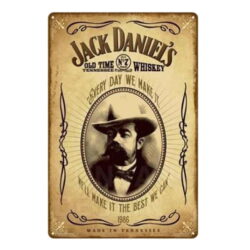
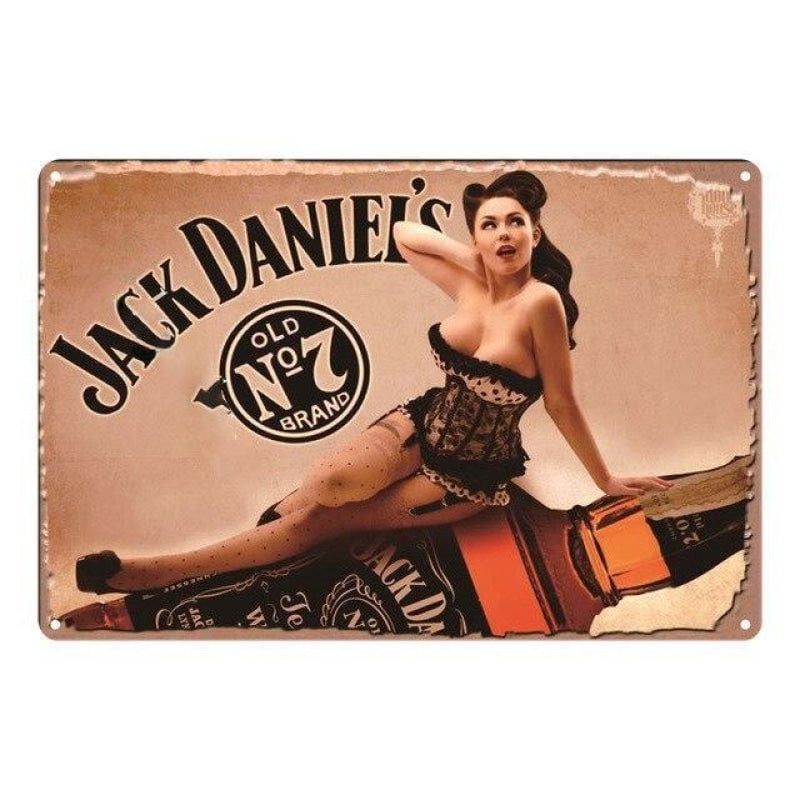




With a sexy pin-up design on a bottle of Jack Daniel’s, this sublime Whisky Decorative Metal Sign will bring charm and celebration to your decor!
- ⚡ WHEN YOU PURCHASE TWO VINTAGE METAL PLATES, THE 3RD IS FREE! ⚡
- Materials:
- Metal protected against corrosion, built to last.
- Very light and easy to install.
- Packaged carefully and placed in a shock-resistant package for safe transport.
- Size: 20 (W) × 30 (L) cm / 30 (W) × 40 (L) cm.
- FREE SECURE DELIVERY & SHIPPED WITHIN 48/72 HOURS (see our FAQs).
Description of this Whisky Decorative Metal Sign
Considered America’s most famous whiskey, Jack Daniel’s 150-year history dates back to 1866, when the first distillery opened. It was the first registered distillery in the United States, founded by Jasper Newton Daniel, who was also the first master distiller.
In 1904, as the brand grew, Old No. 7 earned a gold medal at the World’s Fair—the first of seven gold medals it has won to date.
The journey began when young Jack was taken in by a local preacher named Dan Call after running away from his father’s house because he despised his stepmother.
Until recently, the story went that methylated spirits distiller Call taught his young apprentice, Jack, how to run his Tennessee distillery, but it turns out it was one of Call’s slaves, Nearis Green, who passed on his distilling experience to Daniel.
Uncle “Nearest is the best whiskey maker I know,” Call is quoted as saying in a 1967 biography, Jack Daniel’s Legacy.
Green’s key role in advising Jack Daniel’s had been suspected before, but like that of many slaves, his contribution to the development of American whiskeys was never recorded.
Phil Epps, worldwide brand director of Jack Daniel’s at Brown-Forman, which has owned the distillery for 60 years, insists it was not a “conscious decision” to omit the Greens from the whiskey’s history.
According to Epps, they came across the founder’s story while researching the origin of whiskey.
As we dug into it, we realized it was something to be proud of,” Epps said.
A man believed to be Nearest Green’s son sits next to Jack Daniel on This photo was taken in the late 1800s.
In 1875, Jack founded a registered distilling company with Call using money from his late father’s estate. Shortly after, Call left the company for religious reasons, and Jack became the owner.
In 1884, Jack Daniel purchased the land where the distillery now stands and ran the business until 1907, when he passed the reins to his nephew, Lemuel “Lew” Motlow, since he had never married or had children.
Motlow ran the distillery for 40 years. The company suffered from Prohibition, which was passed in 1910, making it illegal to distill Jack Daniel’s in Tennessee. Motlow challenged the law in a case that went all the way to the Tennessee Supreme Court, but when it was unsuccessful, the company moved production to St. Louis, Missouri, and Birmingham, Alabama, but was unable to achieve the quality of whiskey that was produced in Tennessee. Missouri and Alabama also suffered similar prohibitions, leading to several years of repeals and amendments to the law before the distillery was finally operational in 1947. With World War II reaching its peak, the distillery ceased production in order to redirect its resources to the war effort. Frank Bobo, the head distiller between 1966 and 1988, which transformed Jack Daniel’s from a local whiskey to be sipped in the American South into a world-famous whiskey, with Old No. 7 being as synonymous with rock and roll music as the electric guitar.
With New York City clubs hosting the biggest names in rock and roll, and Jack Daniel’s being a partner at most of these events, the drink’s popularity only grew.
Jeff Arnett is currently the head distiller of Jack Daniel’s, and under his leadership, the brand experienced its biggest expansion in its history, introducing its first flavored expression, Jack Daniel’s Tennessee Honey, and Jack Daniel’s Fire four years later.