


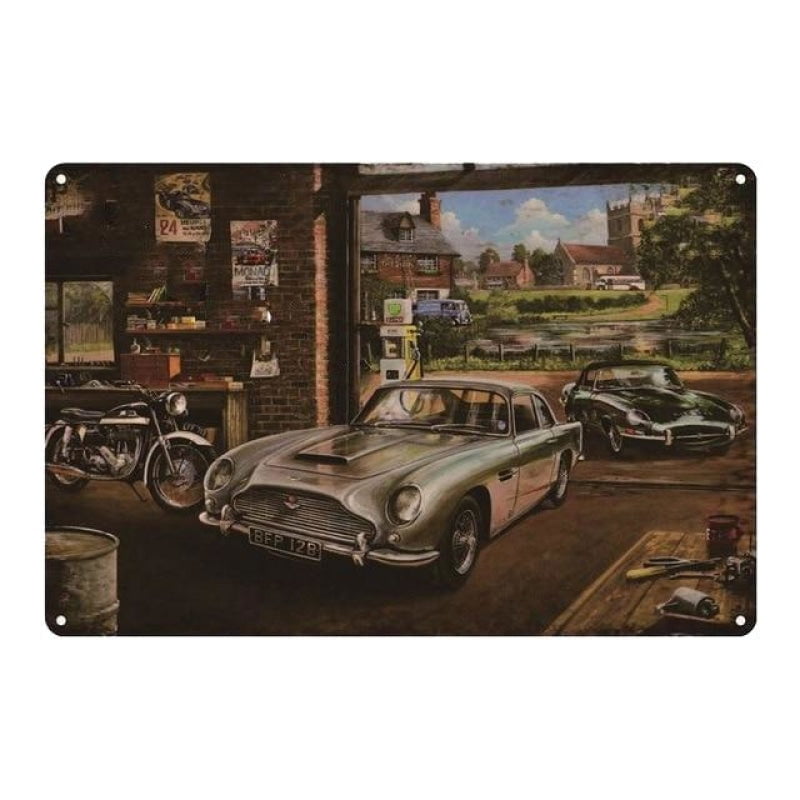




This Aston Martin Metal Sign features the DB5, famous for its appearance in “Goldfinger,” a James Bond film starring Sean Connery.
- ⚡ WHEN YOU PURCHASE TWO VINTAGE METAL PLATES, GET THE 3RD FREE! ⚡
- Materials:
- Metal protected against corrosion, built to last.
- Very light and easy to install.
- Packaged carefully and placed in a shock-resistant package for safe transport.
- Size: 20 (W) × 30 (L) cm / 30 (W) × 40 (L) cm.
- FREE SECURE DELIVERY & SHIPPED WITHIN 48/72 HOURS (see our FAQs).
Description of this Aston Martin Metal Sign
The Aston Martin DB5 is a British luxury grand tourer (GT) car manufactured by Aston Martin and designed by the Italian coachbuilder Carrozzeria Touring Superleggera. Released in 1963, it was an evolution of the later DB4 series.
Although not the first in the DB series, the DB5 is the most famous James Bond car in cinema, first appearing in the film Goldfinger (1964).
DB5 Design
The main differences between the DB4 Series V and the DB5 are the all-aluminum engine, enlarged from 3.7 to 4.0 liters, a new heavy-duty ZF five-speed transmission (except for some very early DB5s), and three SU carburetors. This engine, producing 282 hp (210 kW), which propelled the car to 233 km/h (145 mph), was available on the Vantage (high-power) version of the DB4 since March 1962 and became Aston Martin’s standard engine with the September 1963 launch of the DB5.
Standard equipment on the DB5 included reclining seats, wool-velvet carpets, electric windows, dual fuel tanks, chrome wire wheels, an oil cooler, a magnesium alloy body constructed using the patented Superleggera technique, full leather interior trim, and even a fire extinguisher. All models had two doors and were a 2+2 configuration. The trunk lids differed slightly between the DB4 Mark 5 and the DB5.
Like the DB4, the DB5 used a live rear axle. Initially, the four-speed manual transmission (with optional overdrive) was fitted as standard, but this was soon dropped in favor of the ZF five-speed gearbox. A three-speed Borg-Warner DG automatic transmission was also available. The automatic option was later replaced by the Borg-Warner Model 8 shortly before the DB6 replaced the DB5.