









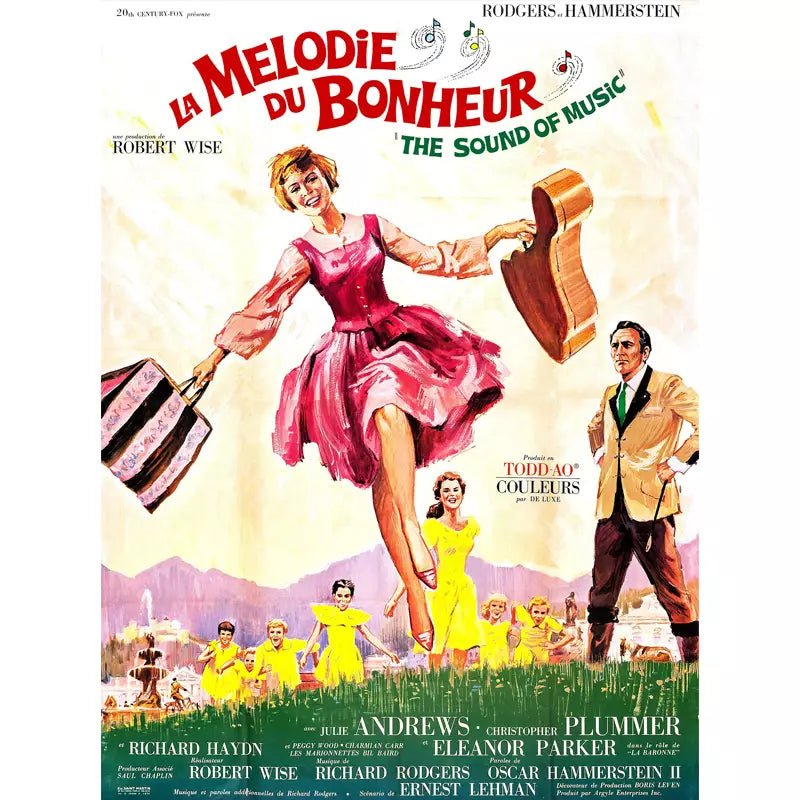































With this The Sound of Music Movie Poster, immerse yourself in a whirlwind of emotions with this cult film. Let yourself be transported by the magic of music and love.
- Paper Feature:
- 🎨 Canvas: global standard in terms of printing and imitating a “painting canvas” look.
- By default, the poster contains a 4cm white border for framing (frame not included). If you don’t want it, please choose “without white border”.
- ✅ Size: several choices available. ✅
- High UV resistance.
- Maximum color brilliance without reflections.
- Recycled paper guaranteed environmental friendliness.
- Poster wrapped carefully and delivered in a protective tube for total protection.
- FREE STANDARD DELIVERY.
⚠️ Frame not included. ⚠️
Description of this The Sound of Music Movie Poster
The Sound of Music is a 1965 American musical film produced and directed by Robert Wise, starring Julie Andrews and Christopher Plummer, Richard Haydn, Peggy Wood, Charmian Carr, and Eleanor Parker. The film is an adaptation of the 1959 musical comedy, composed by Richard Rodgers and with lyrics by Oscar Hammerstein II. The screenplay for the film was written by Ernest Lehman, based on the book of the musical by Lindsay and Crouse. Based on Maria von Trapp’s 1949 memoir, The Story of the Trapp Family Singers, the film tells the story of a young Austrian postulant who, in 1938, is sent to the villa of a widowed, retired naval officer to be the governess of his seven children.
Filming took place from March to September 1964 in Los Angeles and Salzburg. The Sound of Music was released on March 2, 1965, in the United States, initially in a limited theatrical release. Although initial reviews were mixed, the film was a commercial success, becoming the number one film at the box office after four weeks and the highest-grossing film of 1965. By November 1966, The Sound of Music had become the highest-grossing film of all time, surpassing Gone with the Wind, and it held this distinction for five years. The film was equally popular worldwide, breaking box-office records in twenty-nine countries. After an initial theatrical run that lasted four and a half years, and two successful reissues, the film sold 283 million tickets worldwide and grossed a total of $286 million.
The Sound of Music received five Academy Awards, including Best Picture and Best Director, Wise’s second pair of these two awards, the first being for the 1961 film West Side Story. The film also received two Golden Globe Awards, for Best Picture and Best Actress, the Directors Guild of America Award for Outstanding Directorial Achievement, and the Writers Guild of America Award for Best Written American Musical. In 1998, the American Film Institute (AFI) ranked The Sound of Music the fifty-fifth greatest American film of all time and the fourth greatest musical. In 2001, the United States Library of Congress selected the film for preservation in the National Film Registry, deeming it “culturally, historically, or aesthetically significant.”
Maria is a free-spirited young Austrian woman studying to become a nun at Nonnberg Abbey in Salzburg in 1938. Her youthful enthusiasm and lack of discipline raise concerns. The Mother Abbess sends Maria to the villa of retired naval officer Captain Georg von Trapp to be governess to his seven children: Liesl, Friedrich, Louisa, Kurt, Brigitta, Marta, and Gretl. Since his wife’s death, the captain has raised his children alone under strict military discipline. Although the children misbehave at first, Maria reacts with kindness and patience, and soon the children come to trust and respect her.
During the Captain’s absence in Vienna, Maria makes play clothes for the children from curtains that need changing. She shows them around Salzburg and the mountains while teaching them to sing. When the Captain returns to the villa with Baroness Elsa Schraeder, a wealthy socialite, and their mutual friend Max Detweiler, they are greeted by Maria and the children, who are returning from a boat trip on the lake that ends with their boat capsizing. Displeased with his children’s clothing and activities and Maria’s impassioned plea to be closer to them, the Captain tries to send Maria away. But he hears singing inside the house and is surprised to see his children singing to the Baroness. Filled with emotion, the captain joins his children, singing for the first time in years. The captain apologizes to Maria and asks her to stay. Impressed by the children’s singing, Max offers to enter them in the upcoming Salzburg Festival, but the captain does not want his children to sing in public. At a large party at the villa, where guests in evening dress waltz in the ballroom, Maria and the children watch from the garden terrace. When the captain notices Maria teaching Kurt the traditional Ländler folk dance, he intervenes and joins Maria in a graceful performance, which ends with an embrace. Confused about his feelings, Maria blushes and separates from him. Later, the Baroness, who has noticed the Captain’s attraction to Maria, hides her jealousy by indirectly convincing Maria that she must return to the abbey.
However, Mother Abbess learns that Maria has stayed away to avoid her feelings for the Captain, and so she encourages her to return to the villa to seek her purpose in life. When Maria returns to the villa, she learns of the Captain’s engagement to the Baroness and agrees to stay until they find a replacement governess. However, the Baroness learns that the Captain’s feelings for Maria have not changed. So she peacefully calls off the engagement and returns to Vienna, while encouraging the Captain to express his feelings for Maria, who marries him.
While the couple is on their honeymoon, Max signs the children up for the Salzburg Festival against their father’s wishes. Having learned that Austria had been annexed by the Third Reich, the couple returned home, where the captain received a telegram ordering him to report to the German naval base at Bremerhaven to accept a commission in the Kriegsmarine. Firmly opposed to the Nazis, the captain told his family they must leave Austria immediately. That night, the von Trapps attempted to flee to Switzerland, but were stopped by a group of Brownshirts, led by Gauleiter Hans Zeller, who were waiting outside the villa. To cover their tracks, the captain claimed his family was going to the Salzburg Festival to give a concert. Zeller insists on escorting them to the festival, after which his men will accompany the captain to Bremerhaven.
Later that evening at the festival, during their final act, the von Trapps slip away and take refuge at the abbey, where the Mother Abbess hides them in the cemetery crypt. Zeller and his men soon arrive and search the abbey, but the family manages to escape using the caretaker’s car. When they try to give chase, they discover their cars won’t start, as two of the nuns have sabotaged their engines. The next morning, after driving to the Swiss border, the von Trapp family crosses the border on foot to safety and freedom.