


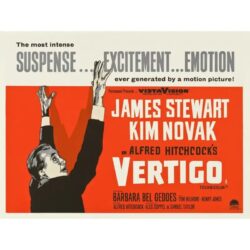
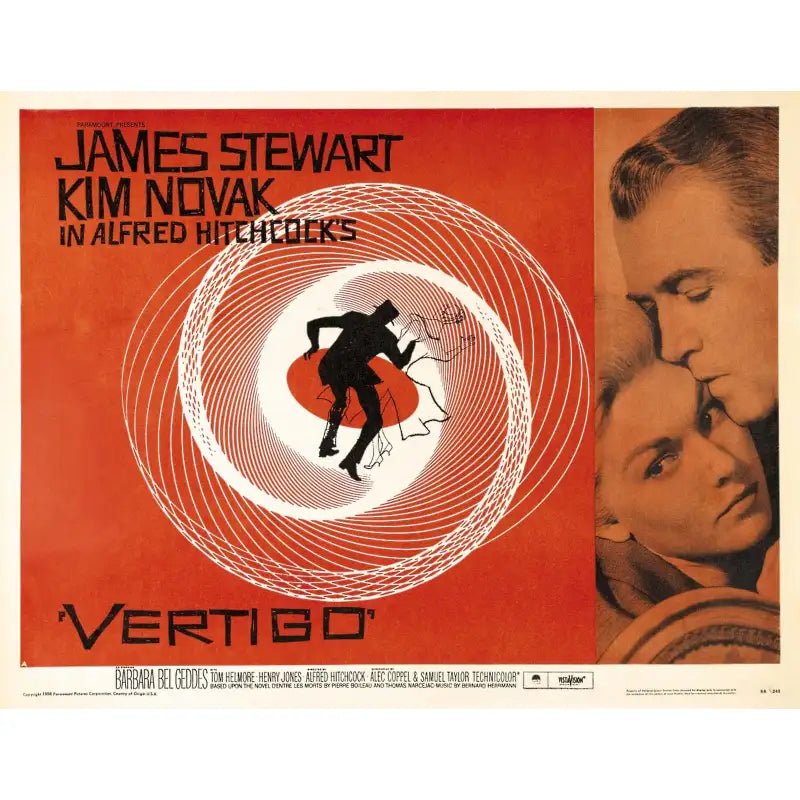
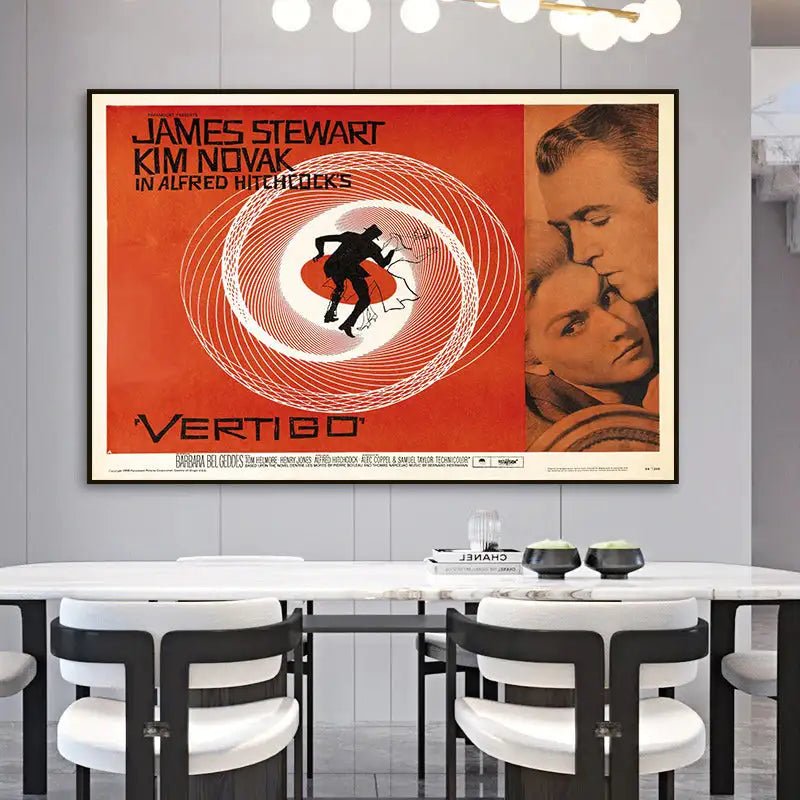

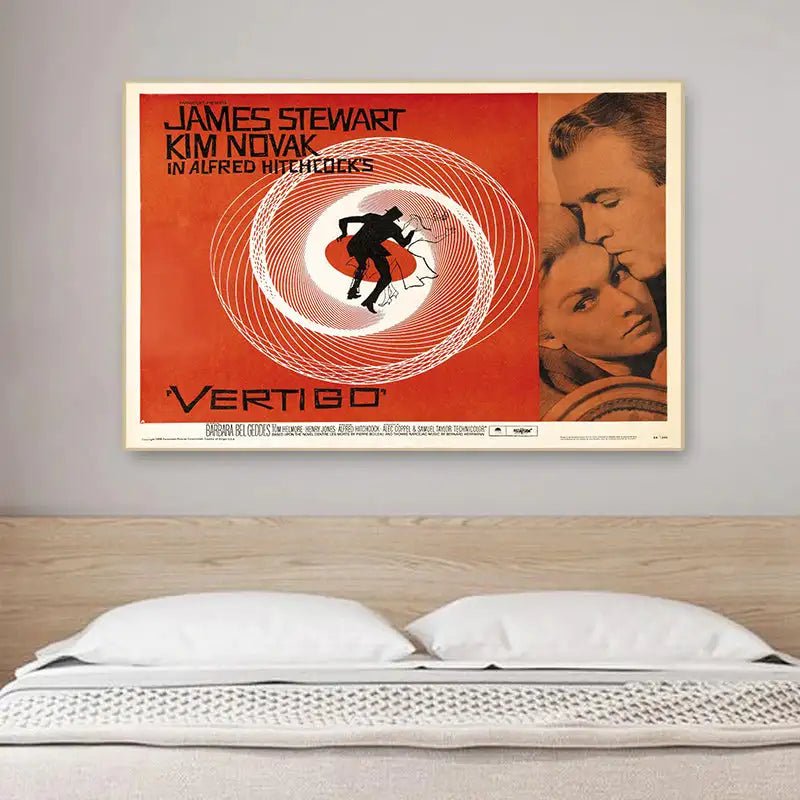



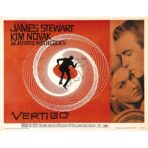















Show your love for Alfred Hitchcock’s masterpiece with this splendid Vertigo Movie Poster that will be perfect for your decor.
- Paper Feature:
- 🎨 Canvas: global standard in terms of printing and imitating a “painting canvas” look.
- By default, the poster contains a 4cm white border for framing (frame not included). If you don’t want it, please choose “without white border”.
- ✅ Size: Multiple choices available. ✅
- High UV resistance.
- Color vibrancy maximum, glare-free.
- Paper recycled, guaranteeing environmental friendliness.
- Poster packaged carefully and delivered in a protective tube for Total protection.
- FREE STANDARD DELIVERY.
⚠️ Frame not included. ⚠️
Description of this Vertigo Movie Poster
Vertigo is a 1958 American psychological thriller and film noir456 film directed and produced by Alfred Hitchcock. The film’s screenplay is based on the 1954 novel From Among the Dead by Pierre Boileau and Thomas Narcejac1, and was adapted by Alec Coppel and Samuel A. Taylor8. 1 and was adapted by Alec Coppel and Samuel A. Taylor.8
Lead actor James Stewart plays private detective John “Scottie” Ferguson who, after suffering an accident that forces him into early retirement and leaves him with acrophobia and vertigo, is hired by an old friend, Galvin Elster (Tom Helmore), to discreetly monitor his wife Madeleine (Kim Novak), who is behaving erratically and appears to be possessed by a spirit. The film is about obsession, psychological and physical paralysis, and the fragile nature of love.9
The film was shot in San Francisco, California, and at Paramount Pictures Studios in Hollywood.10 It was the first film to use compensatory tracking, a camera effect that distorts perspective and was used in the film to create disorientation and convey Scottie’s acrophobia to the viewer.11 Due to its use in the film, the effect is often referred to as the “vertigo effect.”11
The film had its world premiere at the 1958 San Sebastian International Film Festival. Although it had an inauspicious start, with lukewarm reviews and a poor box office reception, it gained popularity over time and is now considered a classic in Hitchcock’s filmography, as well as one of the greatest films of all time.12 13 After a 10-year evaluation, Vertigo was voted the greatest film of all time on August 2, 2012, ahead of Orson Welles’ Citizen Kane. 14 It was nominated for two Academy Awards and topped AFI’s Top 10 list of “Mystery Films.” 15
In 1995, the film was deemed “culturally, historically, and aesthetically significant” by the Library of Congress and selected for preservation in the National Film Registry. 16 A restored version of the film was released in 1996.
After a rooftop chase in which his police partner falls to his death, San Francisco detective John “Scottie” Ferguson (James Stewart) takes early retirement and begins to suffer from acrophobia and vertigo. Scottie tries to overcome his fear by applying his own method, but his friend and former fiancée, underwear designer Marjorie “Midge” Wood (Barbara Bel Geddes), claims that only another severe emotional shock could cure Scottie of his ills.
Later, Gavin Elster, an old college friend of Scottie’s, asks him to shadow his wife, Madeleine, on the grounds that she is not well psychologically and could be endangering her. Scottie agrees, not pleased, and follows Madeleine throughout San Francisco for a day. He follows her to a florist where Madeleine buys a bouquet of flowers, to the Mission Dolores Parish, to the grave of a certain Carlotta Valdes, and to the Legion of Honor Museum of Art, where Madeleine contemplates Carlotta Valdes’ portrait. Finally, Scottie sees her enter the McKittrick Hotel, but when he tries to investigate further and find her, Madeleine doesn’t seem to have entered.
During his investigation, a local historian explains to Scottie that Carlotta Valdes committed suicide: she had been the mistress of a wealthy man, whom she married and with whom she had a daughter, but after a while, the couple separated, taking the child with them. Then Carlotta went mad and ended up killing herself. When Scottie informs Gavin of the investigation, the latter reveals that Carlotta (whom he fears possesses Madeleine) is Madeleine’s great-grandmother, although Madeleine knows nothing of this and has no memory of the places she visited. Scottie follows Madeleine to Fort Point, under the Golden Gate Bridge, and when she jumps into the bay, he saves her.
After Madeleine spends the night in Scottie’s apartment after being rescued, they spend the next day together. They travel all over San Francisco until they reach a bay, where Madeleine jumps into the ocean. Scottie catches her and they kiss. The next day, Madeleine tells him about a nightmare, which Scottie connects to St. John the Baptist Church, Carlotta’s childhood home. He takes her there, and they tell each other they love each other. Madeleine suddenly runs to the church and climbs the bell tower. Scottie, unable to climb the steps due to his acrophobia, sees Madeleine throw herself from the bell tower, killing herself.
Madeleine’s death is ruled a suicide. Gavin doesn’t blame Scottie, but Scottie becomes clinically depressed and enters a sanitarium in a near-catatonic state. After his release, Scottie haunts the places he visited with Madeleine, often imagining he sees her. One day, he believes he identifies Madeleine in a woman who reminds him of her, despite her different appearance. Scottie follows her, and she identifies herself as Judy Barton, from Salina, Kansas. In a flashback, it is revealed that Judy was the person Scottie knew as “Madeleine Elster.” Judy was posing as Gavin’s wife as part of an assassination plot in which the victim was the real Madeleine. Judy writes a letter to Scottie to explain her involvement in the murder: Gavin had deliberately taken advantage of Scottie’s acrophobia so that when Judy went up to the bell tower, he would substitute his wife’s freshly murdered body for Madeleine’s apparent “suicide.” However, Judy tears up the letter and continues the charade because she truly loves Scottie.
After he begins seeing Judy, Scottie is still obsessed with “Madeleine,” so he asks Judy to change her clothes and hair to look like Madeleine. After Judy complies, hoping that they can finally find happiness together, he notices that Judy is wearing the necklace depicted in Carlotta’s painting and realizes the truth: that Judy had been Elster’s mistress before being cast aside as Carlotta, to be part of the plot to murder the real Madeleine. So, Scottie insists on taking Judy to St. John the Baptist.
There, Scottie tells Judy that he must piece together the event that led to her madness, admitting that he now understands that “Madeleine” and Judy are the same person. Scottie forces her up into the bell tower and makes her confess her deception. Scottie reaches the top, finally conquering and overcoming her fear of heights and acrophobia. Judy confesses that Gavin paid her to pose as a “possessed” Madeleine and that he faked the real Madeleine’s suicide by throwing his wife’s body from the top of the bell tower. Judy begs Scottie for forgiveness because she loves him. He kisses her, but a figure hidden in the shadows emerges from the tower’s trapdoor, startling Judy, who takes a step back and falls. Scottie, again overcome with grief, stands on the ledge as the figure, a nun who has been investigating the noises, rings the bell in the church tower.