



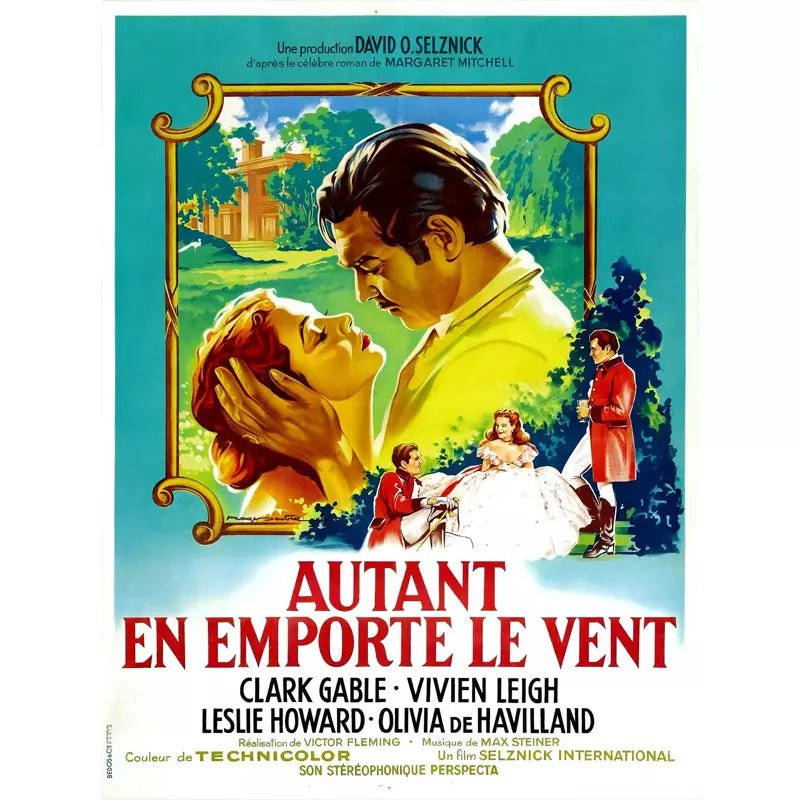































Dive into the heart of a passionate and tumultuous love story in this captivating Gone With the Wind Poster. This iconic work evokes the deep emotions and torments of a troubled era, transporting viewers to a world where love confronts war, passion against destruction. Let yourself be captivated by this poster that reveals all the grandeur and intensity of the famous film that has become a cinema classic.
- Paper Feature:
- 🎨 Canvas: global standard in terms of printing and imitating a “painting canvas” look.
- By default, the poster contains a 4cm white border for framing (frame not included). If you don’t want it, please choose “without white border”.
- ✅ Size: several choices available. ✅
- High UV resistance.
- Maximum color brilliance without reflections.
- Recycled paper guaranteed environmental friendliness.
- Poster wrapped carefully and delivered in a protective tube for total protection.
- FREE STANDARD DELIVERY.
⚠️ Frame not included. ⚠️
Description of this Gone With the Wind Poster
Gone With the Wind is a 1939 American historical epic film adapted from the 1936 novel by Margaret Mitchell. The film was produced by David O. Selznick of Selznick International Pictures and directed by Victor Fleming. Set in the American South, against the backdrop of the Civil War and Reconstruction, the film tells the story of Scarlett O’Hara (Vivien Leigh), the strong-willed daughter of a Georgia plantation owner, who pursues Ashley Wilkes (Leslie Howard), married to her cousin Melanie Hamilton (Olivia de Havilland), and her marriage to Rhett Butler (Clark Gable).
The film Gone With the Wind had a turbulent production. The start of filming was delayed for two years, until January 1939, due to Selznick’s determination to secure Gable for the role of Rhett, and was completed the following July. The role of Scarlett was difficult to cast, and 1,400 unknown women were interviewed for the part. Sidney Howard’s original script underwent numerous revisions by several screenwriters to bring it down to a suitable length. The original director, George Cukor, was fired shortly after filming began and replaced by Fleming, who in turn was briefly replaced by Sam Wood, who took a leave of absence due to exhaustion. Post-production was completed in November 1939, just one month before the premiere.
The film received generally positive reviews upon its release on December 15, 1939. While the casting was widely praised, the film’s long running time was criticized. At the 12th Academy Awards, Gone with the Wind received ten Oscars (eight in competition, two honorary) out of thirteen nominations, including Best Picture, Best Director (Fleming), Best Adapted Screenplay (awarded posthumously to Sidney Howard), Best Actress (Leigh), and Best Supporting Actress (Hattie McDaniel, who became the first African American to win an Oscar). It broke the record for the total number of wins and nominations at the time.
Gone with the Wind was immensely popular upon its release. It became the highest-grossing film of its time and held that record for over a quarter of a century. Adjusted for monetary inflation, it remains the highest-grossing film in history. The film was reissued periodically throughout the 20th century and has become ingrained in popular culture. Although the film has been criticized for its historical denial, glorifying slavery, and the myth of the Confederacy’s Lost Cause, it is credited with sparking changes in the portrayal of African Americans in cinema. Gone with the Wind is considered one of the greatest films of all time and, in 1989, became one of the first twenty-five films selected for preservation in the United States National Film Registry.
In 1861, on the eve of the American Civil War, Scarlett O’Hara lives on Tara, her family’s cotton plantation in Georgia, with her parents, two sisters, and their numerous Black slaves. Scarlett is deeply attracted to Ashley Wilkes and learns that he is to marry her cousin, Melanie Hamilton. The next day, at an engagement party at Ashley’s home, Twelve Oaks, a nearby plantation, Scarlett makes advances toward Ashley but is rebuffed; however, she catches the eye of another guest, Rhett Butler. The party is interrupted by news of President Lincoln’s call for volunteers to fight the South, and Southern men rush to enlist. Scarlett marries Melanie’s younger brother, Charles, to arouse Ashley’s jealousy before he goes into battle. After Charles’s death while serving in the Confederate States Army, Scarlett’s mother sends her to live with the Hamiltons in Atlanta. She creates a stir by attending a charity gala in mourning attire and waltzing with Rhett, now a blockade runner for the Confederacy.
After the Battle of Gettysburg, the tide of war turns against the Confederacy. Many men from Scarlett’s town are killed. Eight months later, as the Union army besieges the town as part of the Atlanta Campaign, Melanie gives birth with Scarlett’s help, and Rhett helps them flee the town. Rhett chooses to go fight, leaving Scarlett to fend for herself and return to Tara. She finds Tara deserted except for her father, sisters, and former slaves, Mammy and Pork. Scarlett learns that her mother has just died of typhoid fever and her father has lost his mind. As Tara is pillaged by Union troops and the fields are left untended, Scarlett vows to ensure her and her family’s survival.
After the Confederacy’s defeat, the O’Haras work in the cotton fields. Ashley returns but finds he is of little help to Tara. When Scarlett begs him to run away with her, he confesses his desire for her and kisses her passionately, but says he cannot leave Melanie. Scarlett’s father attempts to drive a carpetbagger off his land, but is thrown from his horse and killed. Unable to pay the Reconstructionist taxes imposed on Tara, Scarlett tricks her younger sister Suellen’s fiancé, the wealthy, middle-aged general store owner Frank Kennedy, into marrying her by saying that Suellen grew tired of waiting and married another suitor. Frank, Ashley, Rhett, and several other accomplices conduct a nighttime raid on a shantytown after Scarlett is attacked while driving alone, resulting in Frank’s death. Shortly after Frank’s funeral, Rhett proposes to Scarlett, which she accepts.
Rhett and Scarlett have a daughter whom Rhett names Bonnie Blue, but Scarlett still pines for Ashley and, upset by the perceived ruin of her figure, refuses to have any more children or share a bed with Rhett. One day at Frank’s factory, Ashley’s sister India sees Scarlett and Ashley kissing. India, who has a deep dislike for Scarlett, is quick to spread rumors. Later that evening, Rhett, having heard the rumors, forces Scarlett to attend a birthday party for Ashley. Melanie, however, stays by Scarlett’s side. Back home, Scarlett finds Rhett downstairs drunk, and they argue about Ashley. Rhett kisses Scarlett against her will, declaring his intention to have sex with her that night, and carries the struggling Scarlett to the bedroom. The next day, Rhett apologizes for his behavior and offers Scarlett a divorce, which she refuses, saying it would be a disgrace. When Rhett returns from a long trip to London, Scarlett informs him that she is pregnant, but an argument ensues, and she falls down the stairs, suffering a miscarriage. While recovering, tragedy strikes again when Bonnie dies while attempting to jump a fence with her pony. Scarlett and Rhett visit Melanie, who has suffered complications from another pregnancy, on her deathbed. While Scarlett consoles Ashley, Rhett prepares to leave Atlanta. Realizing that it was him, not Ashley, that she truly loved all along, Scarlett begs Rhett to stay, but he pushes her away and walks off into the morning fog. A distraught Scarlett decides to return home to Tara, vowing to one day win Rhett back.