


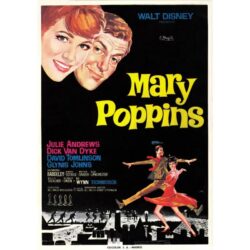



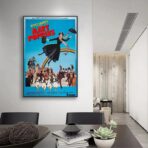
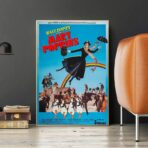


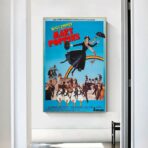







Musical and Disney fans will be in heaven with this Mary Poppins Movie Poster in shimmering retro colors!
- Paper Feature:
- 🎨 Canvas: global standard in terms of printing and imitating a “painting canvas” look.
- By default, the poster contains a 4cm white border for framing (frame not included). If you don’t want it, please choose “without white border”.
- ✅ Size: Multiple choices available. ✅
- High UV resistance.
- Color vibrancy maximum, glare-free.
- Paper recycled, guaranteeing environmental friendliness.
- Poster packaged carefully and delivered in a protective tube for Total protection.
- FREE STANDARD DELIVERY.
⚠️ Frame not included. ⚠️
Description of this Mary Poppins Movie Poster
Mary Poppins is a 1964 musical fantasy film directed by Robert Stevenson, produced by Walt Disney, and featuring songs written by the Sherman Brothers. The screenplay, written by Bill Walsh and Don DaGradi, is based on the Mary Poppins series of novels by Pamela Lyndon Travers. The film, which contains scenes combining live action and animation, stars Julie Andrews as Mary Poppins, a magical nanny who visits a dysfunctional family in London and uses her unique style to improve their lives. The cast also stars Dick Van Dyke, David Tomlinson, and Glynis Johns, among others. It was filmed entirely at the Walt Disney Studios in Burbank, California, using painted London backdrops. It was released to great acclaim and was nominated for thirteen Academy Awards, including Best Picture, a record unbroken by any other Walt Disney Studios film. It won five: Best Actress for Julie Andrews, Best Film Editing, Best Score, Best Visual Effects, and Best Original Song for Chim Chim Cher-ee. In 2006, it was ranked 6th on the American Film Institute’s list of the best American musicals.2 In 2013, the film was selected for preservation in the National Film Registry by the Library of Congress as being “culturally, historically, or aesthetically significant.”3 Mary Poppins is considered Walt Disney’s crowning achievement, being the only one of his films to earn an Academy Award nomination for Best Picture during his lifetime.
In 1910s Edwardian London, the Banks’ last nanny, Katie Nanna, leaves her position after Jane and Michael (the children of George and Winifred Banks) run away for the fourth time in a week.
George (Jane and Michael’s father) comes home from work and Winifred (the mother) reveals that the children have disappeared. The police arrive with the children, who ask their father to help them repair their damaged kite, but he refuses and advertises for a replacement nanny in a very authoritarian manner. Jane and Michael write a letter asking for a kind and compassionate person, but George tears up the paper and throws it in the fireplace, because he thinks it’s silly, and asks for the phone number of The Times to place an advertisement. Unnoticed, the remains of the note float up the chimney. The next day, Mary Poppins, a kind and compassionate nanny, arrives. Upon returning to the nanny’s job, George is surprised to see her holding the reassembled fragments of the advertisement he had torn up. This defiant new nanny describes herself as a firm nanny who will set the rules for the children. While George is still puzzled, Mary begins the job, arguing that she will stay for a one-week trial period before deciding whether to accept the position permanently. When she joins the children, they are amazed by what Mary Poppins has in a suitcase with infinite accessories and the magic within it. After tidying their room, Jane and Michael slide down the banister for a walk in the park. This way, they meet Bert at the park entrance. Bert now works as a cartoonist, drawing pictures with colored chalk on the sidewalk, and when he sees Mary Poppins’s shadow, he begins to draw the silhouette. It is there that Mary Poppins uses one of Bert’s drawings as a gateway to an animated field. In the drawing, the children follow a path to a funfair while Mary and Bert enjoy a walk in the countryside, during which Bert dances in an open-air restaurant with four penguin waiters. Mary Poppins and Bert join the children on the merry-go-round. The quartet ends up in a horse race, which Mary wins. It is here that Mary Poppins first uses the nonsensical word “supercalifragilisticoespialidoso.” Their departure is interrupted by a storm, which erases the chalk drawing and sends the travelers back to the park. After tidying their room, Jane and Michael slide down the banister for a walk in the park. This way, they meet Bert at the park entrance. Bert now works as a draftsman; he draws pictures with colored chalk on the sidewalk, and when he sees Mary Poppins’s shadow, he begins to draw her silhouette. This is where Mary Poppins uses one of Bert’s drawings as a gateway to a lively field. In the drawing, the children follow a path to a funfair while Mary and Bert enjoy a walk in the countryside, during which Bert dances in an outdoor restaurant with four penguin waiters. Mary Poppins and Bert join the children on the merry-go-round. The quartet ends up in a horse race, which Mary wins. This is where Mary Poppins first uses the nonsense word “supercalifragilisticoespialidoso.” The departure is interrupted by a storm, which erases the chalk drawing and sends the travelers back to the park. At bedtime, the children ask Mary Poppins how long she will stay with them, and she agrees to stay until the wind changes. She then sternly rejects the idea that she has won a horse race in the countryside, but the children are very restless after everything they have seen that day and do not want to go to sleep, but she lulls them with a lullaby, the lyrics of which speak precisely to what they feel like doing at that moment, which is to stay awake even though it is bedtime. The next day, they visit Mary Poppins’s uncle Albert, after learning that his non-stop laughter has made him float to the ceiling. They join him for tea on the roof of his house, telling each other various jokes, although Mary Poppins finds this ridiculous. The only way for them to discourage themselves is to think of something sad, but they are unable to do this, as they return to thinking of something happy. When Mary Poppins firmly states that it is time for everyone to go home, it makes Uncle Albert sad, even though Jane and Michael promise they will return. Bert tries to tell him a joke to cheer him up, but he fails and breaks down in tears too. George seems increasingly bored by tales of his children’s adventures, but Mary Poppins easily reverses his attempt to sternly instruct him that he should instill discipline and order in his children into a plan to take his children with him to his bank. On the way, as they pass St. Paul’s Cathedral, they become aware of the Pigeon Woman, ask their father to listen to what the woman is saying, and she asks them to buy food for the pigeons. The children try to tell him what the nanny is saying, but George only expresses his lack of interest in what Mary Poppins is saying. Arriving at the bank, Mr. Dawes Jr. and Mr. Dawes Sr. (the owners of the bank where George works) try to convince Michael to deposit his two pennies in the bank by singing a song about the things he’ll have if he doesn’t waste the money, going so far as to snatch it from his hands without waiting for his permission. When Michael protests, the other customers don’t understand his shouts, and there’s a huge commotion in the bank that forces business to a halt, as suddenly everyone who had invested their money starts demanding their money back. The bank guard (Jimmy Logan) chases the children, who eventually escape through the London slums. Luckily, they meet Bert, who has become a chimney sweep. He brings them home safely, after explaining that their father doesn’t hate them, but he has his own problems and, unlike the children, he can only rely on himself. At home, Winifred employs Bert to clean the family chimney and look after the children. Mary Poppins arrives after her day off and warns of the dangers of this activity, but it is too late, as the children are sucked up the chimney together and onto the roof. Bert and Mary follow them and take a tour of the London rooftops, which ends with a joyous dance with Bert’s chimney-sweeping colleagues. Admiral Boom, mistaking them for Hottentots, sets off a hail of fireworks that sends the entire group back up a chimney, which turns out to be the Banks’. As everyone dances around the house, George arrives home, sending Bert’s helpers into the street, where they disappear. George becomes upset and wonders what’s going on, to which Mary Poppins replies that she never explains herself to anyone. George then receives a phone call from work ordering him to return immediately for disciplinary action. As George gathers his strength, blaming Mary Poppins for all his misfortunes, Bert points out that even though George is trying to earn a living, Jane and Michael are children and he needs to be a part of their childhood, before they grow up. Jane and Michael apologize, and Michael gives him his money in the hopes that it will make things better. George graciously accepts the offer.
George walks alone through the night streets of London, noticing several of the buildings around him, such as the cathedral and the steps where the pigeon woman had been sitting earlier. At the bank, he undergoes a demotion ceremony and is fired for causing the first run on the bank since 1773 (the bank provided the money for the tea shipment destroyed in the Boston Tea Mutiny). However, after being ordered to make a statement, George says “supercalifragilisticoespialidoso” and gives Dawes his son’s dough, tells one of Uncle Albert’s jokes, and happily leaves. Dawes Sr. thinks about the joke and eventually climbs onto the roof laughing.
The next morning, with the wind having changed direction, Mary Poppins prepares to leave. Meanwhile, the police cannot find George and fear he may have committed suicide. However, George, now loving and cheerful, reappears with the repaired kite for Jane and Michael. Winifred uses one of her suffragette ribbons as the kite’s tail. In the park, Mr. Dawes Jr., now the bank manager, says his father literally died laughing at his joke. George offers his condolences, but Mr. Dawes Jr. explains that his father died happy and rehires him to fill the void as a junior partner. Once her work is done, Mary Poppins opens her umbrella and flies into the air. Bert bids her a fond farewell and asks her to come back soon.