


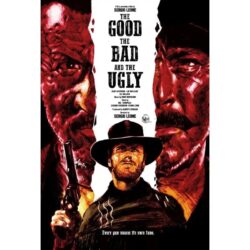
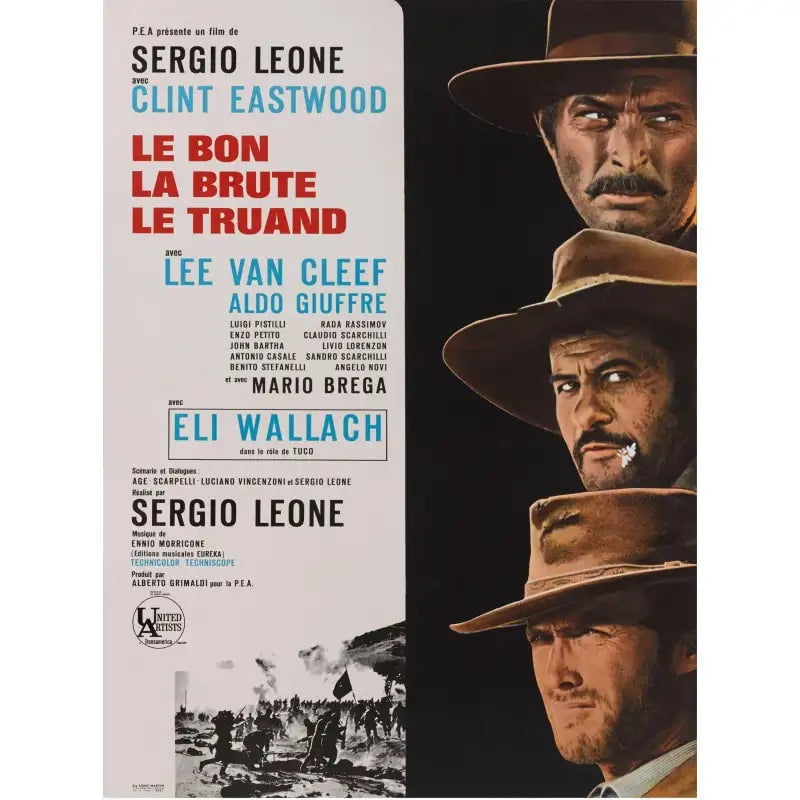
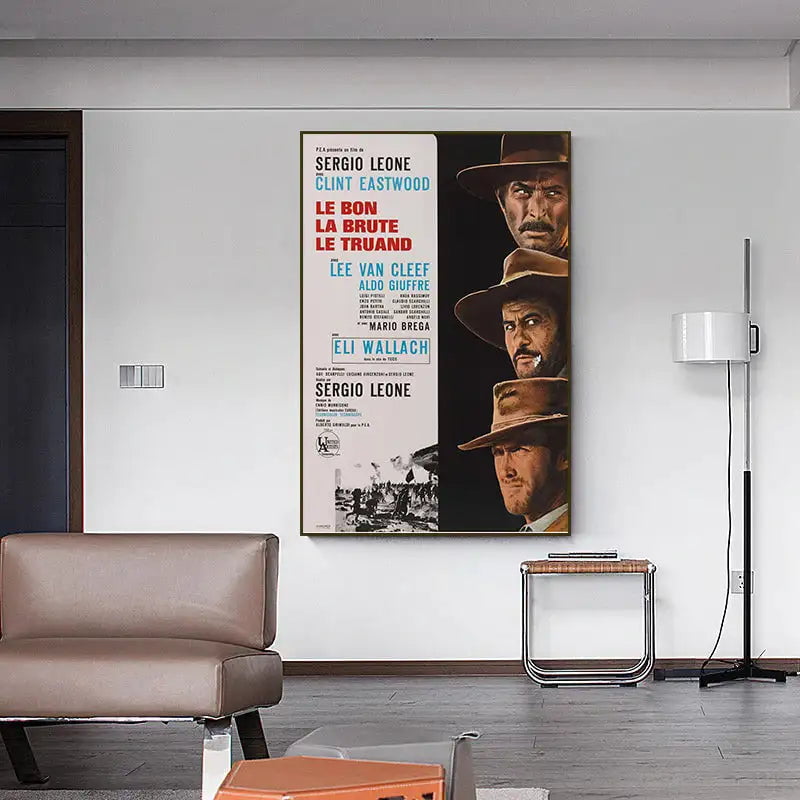
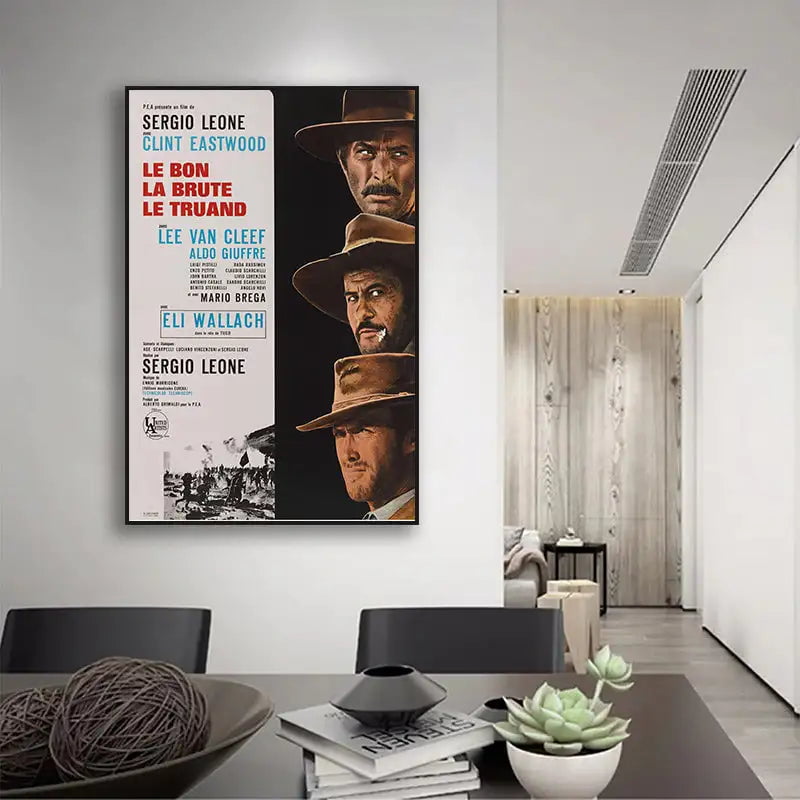
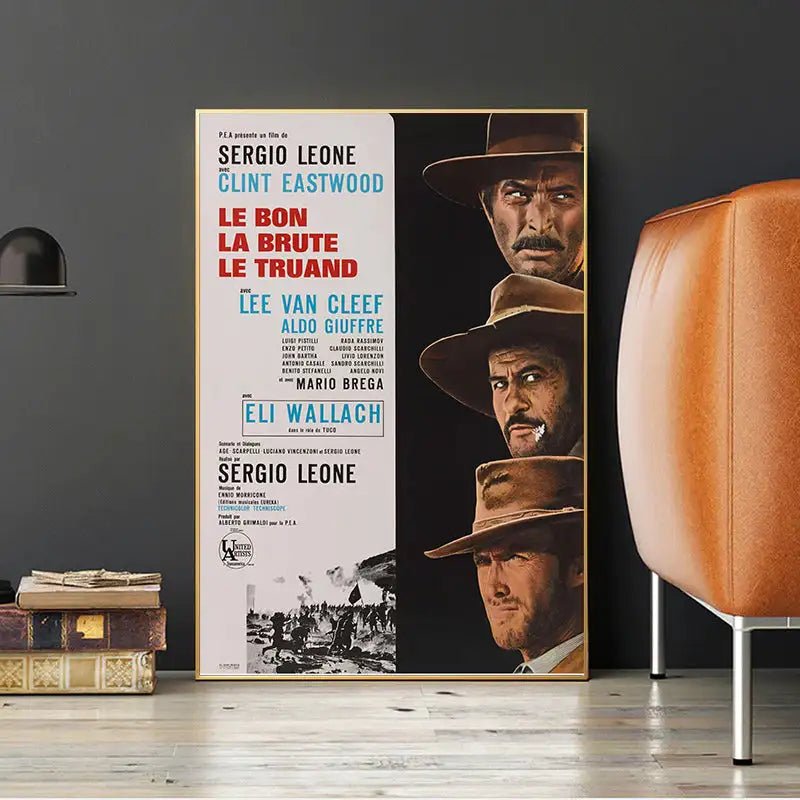
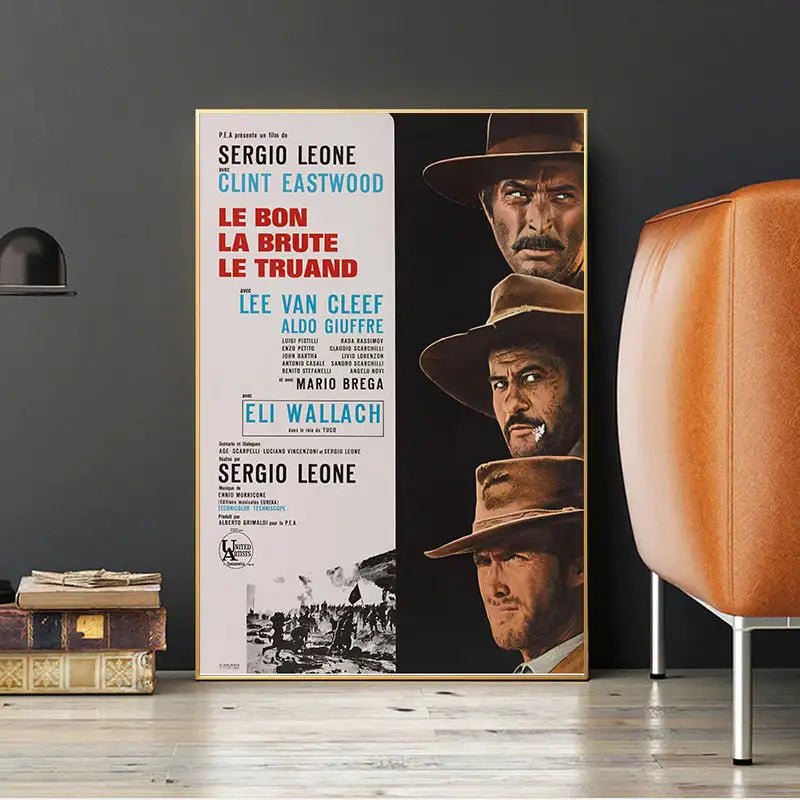
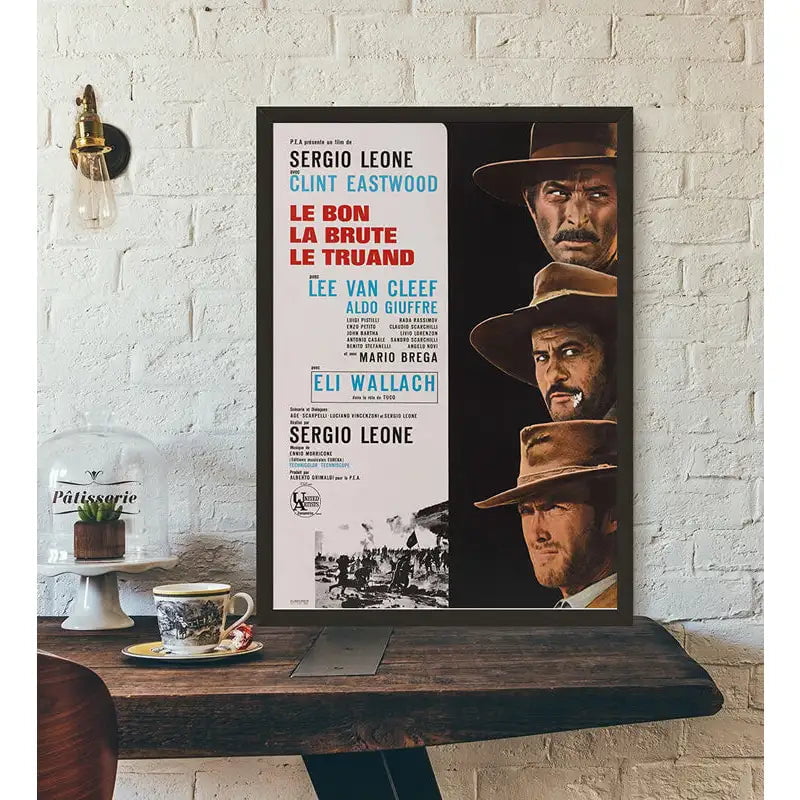
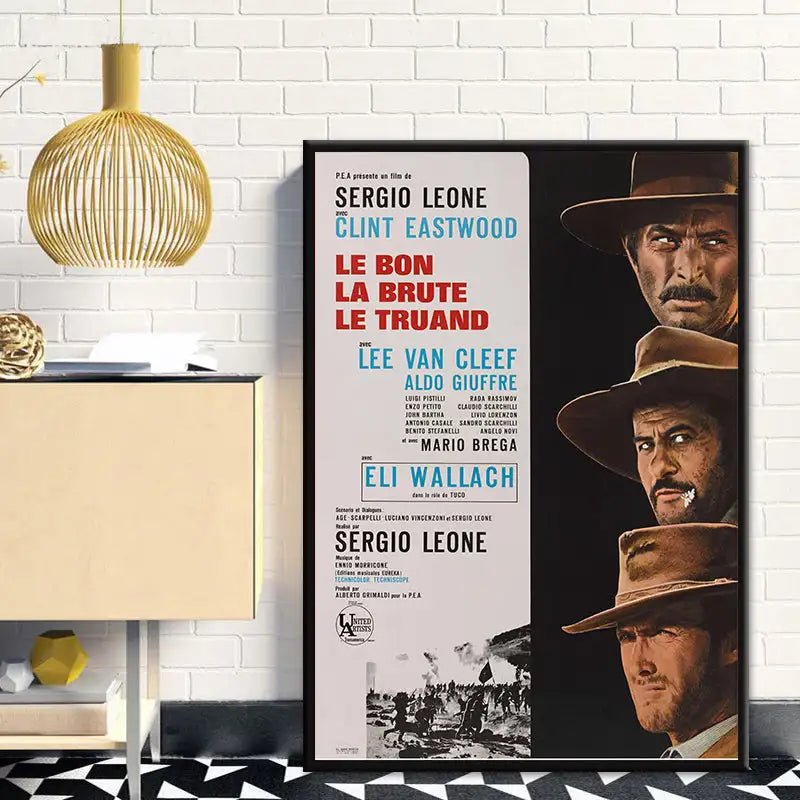
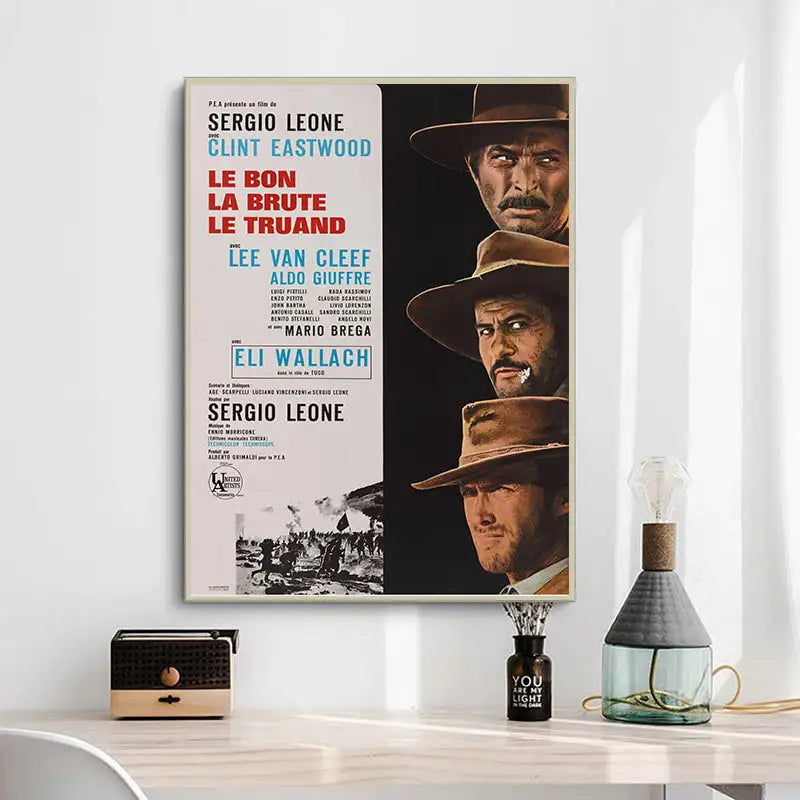
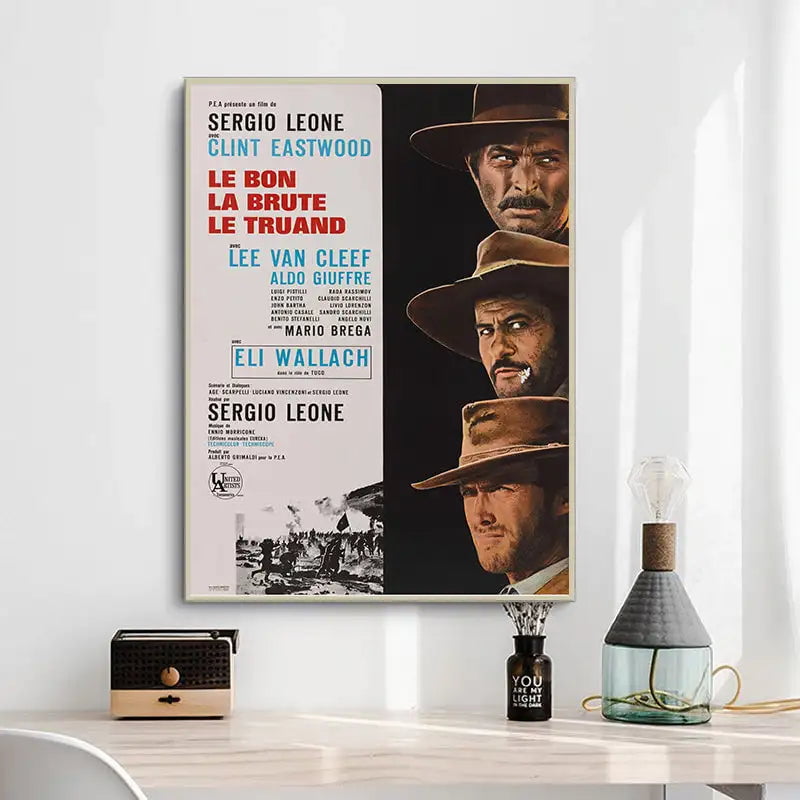
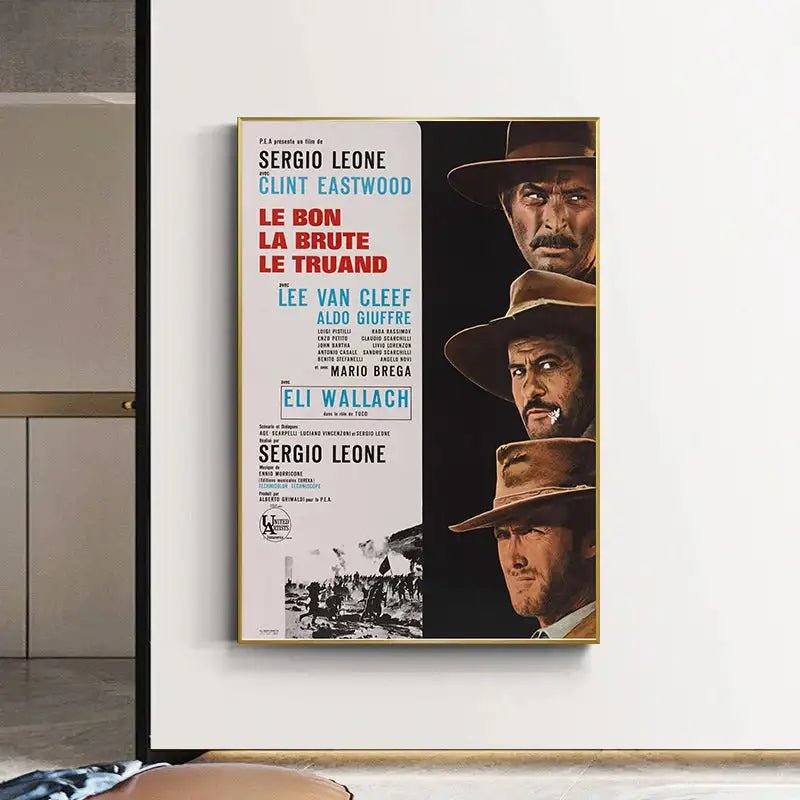
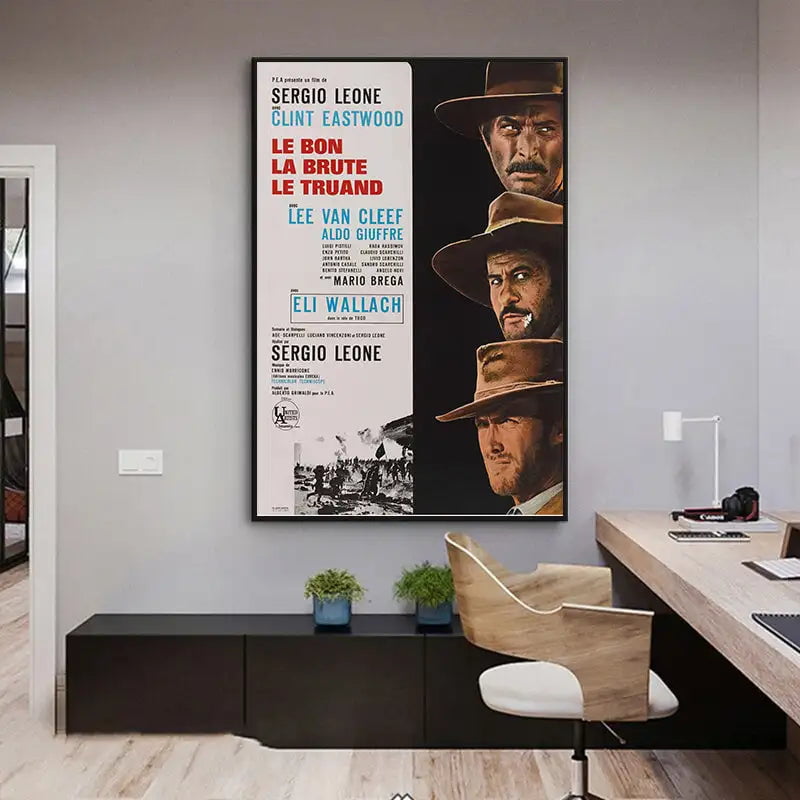
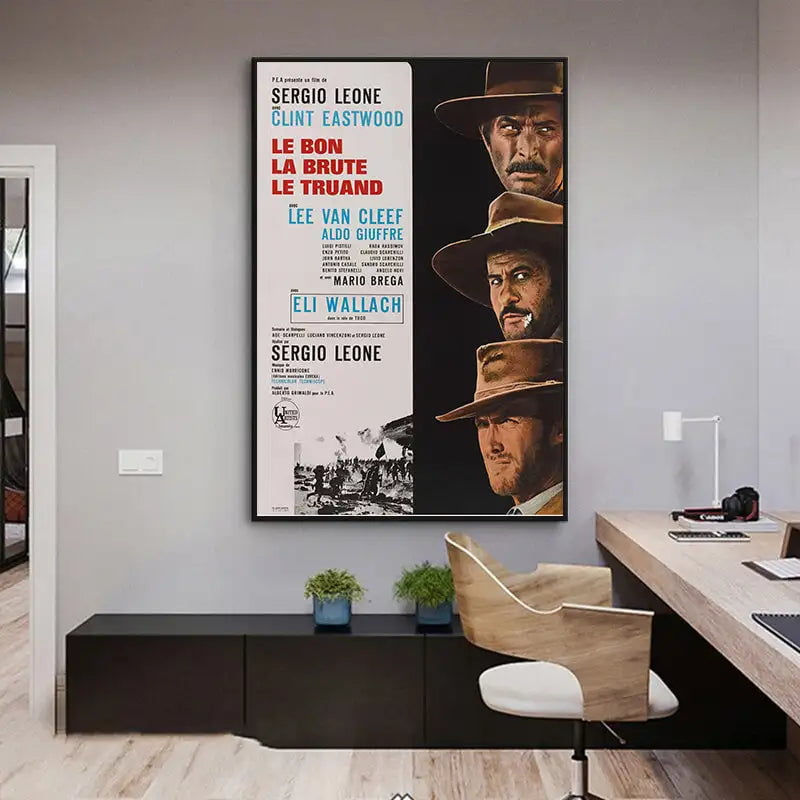
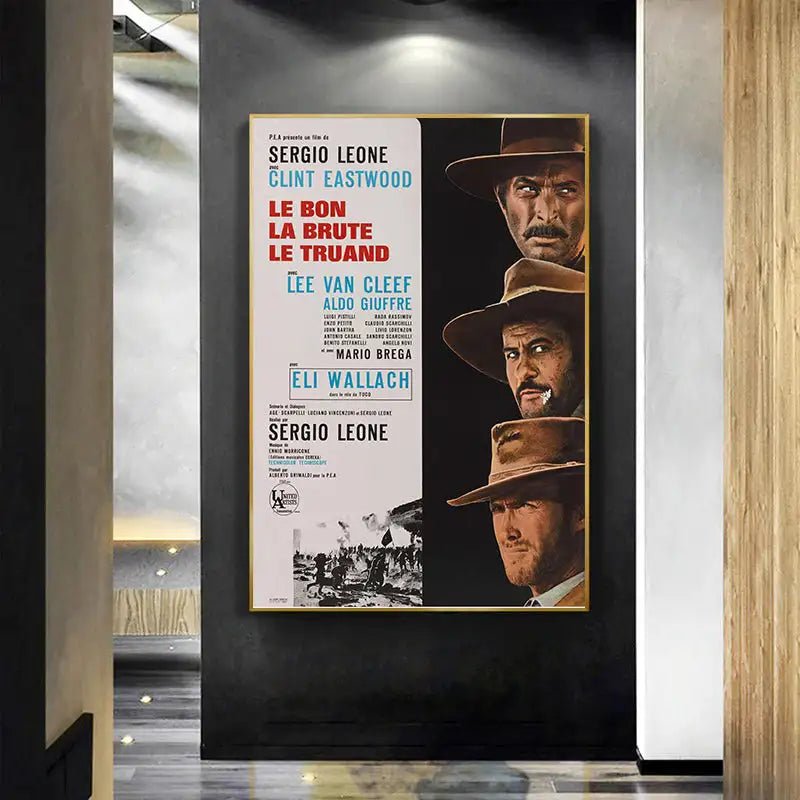
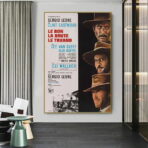
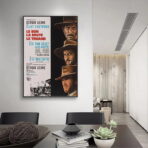
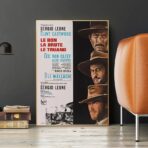
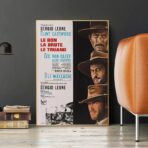
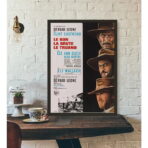
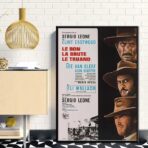
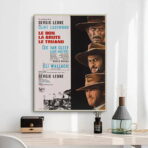
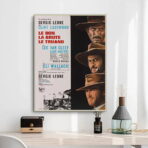
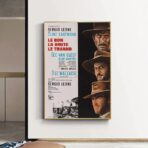
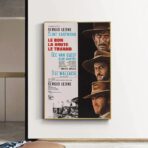
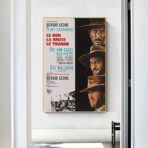


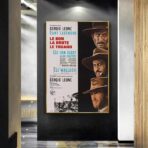










Rediscover the latest masterpiece and film directed by Sergio Leone with this superb The Good, the Bad and the Ugly Poster that will please all spaghetti western fans!
- Paper Feature:
- 🎨 Canvas: global standard in terms of printing and imitating a “painting canvas” look.
- By default, the poster contains a 4cm white border for framing (frame not included). If you don’t want it, please choose “without white border”.
- ✅ Size: Multiple choices available. ✅
- High UV resistance.
- Color vibrancy maximum, glare-free.
- recycled paper, guaranteeing environmental friendliness.
- Poster packaged carefully and delivered in a protective tube for Total protection.
- FREE STANDARD DELIVERY.
⚠️ Frame not included. ⚠️
Description of this The Good, the Bad and the Ugly Poster
The Good, the Bad and the Ugly is a 1966 film directed by Sergio Leone.
One of the most famous westerns in the history of cinema, it is considered the epitome of the hit spaghetti western genre and one of the best films of all time. Shot in the wake of the success of A Fistful of Dollars and A Few Dollars More, the film concludes Sergio Leone’s Dollar Trilogy. To avoid repeating himself once again, the director further increases the number of protagonists, from two to three, and sets the plot in the historical context of the American Civil War.
The title, Born by Chance, reflects Leone’s thinking. In the three protagonists, each in their own autobiographical way, beauty and ugliness, humanity and ferocity coexist: the director demystifies all these concepts and at the same time, in a declared denunciation of the madness of war, he demystifies the very history of the United States of America, showing its violent and brutal side, tarnished by the mythologizing tradition of the Western epic.
Leone reproduces the cliché of the man with no name, played by Clint Eastwood, but makes him more ambiguous, halfway between the bounty hunter and the executioner. Alongside Eastwood in the leading roles are Lee Van Cleef (also a veteran of For a Few Dollars More, but here in a very different role) and Eli Wallach. Also noteworthy is the participation of Aldo Giuffré in the role of a captain in the Union army. But it is above all the character of Tuco that stands out, both for the depth of his experience and his inner dimension and for the presence of a humorous side masterfully characterized by Wallach’s comic talent.
The “triello” scene (a Mexican-style confrontation) in the film’s finale remains exemplary, both for its direction and editing and for the skillful use of Ennio Morricone’s soundtrack (Il triello track), which uniquely underlines it, adding tension and evocative power.
The film initially divided critics, but was a huge success with audiences. Its popularity has never waned and has made it a classic of cinema, music, and comics. Users and readers of specialist websites and magazines, as well as prominent filmmakers like Quentin Tarantino, consider it one of the best films of all time.
Set against the backdrop of the American Civil War, the bandit Tuco Benedicto Pacífico Juan María Ramírez is captured by three bounty hunters. A fourth mysterious gunman then intervenes and saves the bandit, before handing him over to the courts, who sentences him to death. During the hanging, the unknown “bounty killer” cuts the noose with a shotgun, allowing Tuco to escape, and then shares the bounty with him. The two men agree to repeat the heist, but the nameless man, whom Tuco calls “the Blond,” after one last success, breaks off their partnership, abandoning the bandit in the desert, trapped and bound.
Meanwhile, a ruthless hitman known as Sentenza is hired by Becker, a disabled Confederate soldier, to find Jackson, a former comrade in arms. During his search, Sentenza learns that Jackson has changed his name to Bill Carson and is likely involved in the disappearance of a briefcase containing $200,000 in gold stolen from the Confederate army. He thus understands the intention of his sponsor. Sentenza quickly dismisses Becker and resumes the search for Carson, discovering that he has reenlisted in the army and lost an eye. Tuco, who survived the desert, pulls himself together and sets out to seek revenge on Blond. After a first unsuccessful attempt to kill him, he captures him and forces him to cross the desert on foot, without water or protection from the sun. After a long walk, always on the verge of shooting him, he is distracted by a driverless stagecoach loaded with dead Confederate soldiers. He rushes to loot it and discovers a dying survivor, Bill Carson, who promises him $200,000 in exchange for water. Before dying, the soldier reveals the hiding place of the treasure, partly to Tuco and partly to Blond. The former discovers that the money is buried in the Sad Hill cemetery, while the latter only knows the grave in which it is located.
Forced to save Blond to find the loot, Tuco manages to transport it to the Franciscan mission of Saint Anthony and save it. Before leaving, he has a bitter argument with his brother Pablo, prior of the convent, who reproaches him for his career as a bandit and with whom he comes to blows.
Sentenza, to find Carson, enlisted in the Northern Army, obtaining the rank of sergeant and the direction of a prison camp. By chance, Tuco and Blond are captured by the Unionists and taken to this same camp, where Tuco has the bad idea of giving Bill Carson’s false coordinates. Tortured by the rude and brutal Corporal Wallace, he reveals to Sentenza the name of the cemetery, and that only Blond knows the exact grave. He is then handed over to Wallace himself to be taken to the gallows. Sentenza, convinced that Blond is too clever to reveal the name on the grave, suggests that the latter join him in the search for the money.
But Tuco, traveling on a train, although handcuffed, manages to kill Wallace and escape, taking refuge in a bombed-out city. In the same city, Blond and Sentenza also arrive, accompanied by five armed men in the latter’s pay. Tuco, meanwhile, encounters an old enemy by chance, whom he manages to kill with several shots. Blond recognizes “the voice” of Tuco’s pistol, joins him, and allies with him against Sentenza’s gang, which is exterminated. Only Sentenza survives, losing his own trail.
Back on the road, the former partners encounter the insurmountable obstacle of Langstone Bridge, around which the war rages. Discovered by nearby Northerners, they pretend to want to enlist. Captain Clinton, who greets them in a drunken state, reveals that the bridge is strategic and that to capture it, the armies clash in a long series of merciless battles, at the cost of many lives. The officer, driven by a great sense of humanity, would like to put an end to the massacre, but the only possible way would be to blow up the bridge, under penalty of being tried for treason.
The idea is taken up by the two men, who think only of leaving the battlefield to continue their journey. During the truce that follows another bloody confrontation, they undermine the bridge. Faced with the high risk of being killed in the adventure, Tuco and Blond reveal to each other their share of the secret concerning the location of the chest containing the money: Blond thus learns the name of the cemetery, and reveals to Tuco that the name inscribed on the tomb is Arch Stanton. The mined bridge explodes, just in time to satisfy the captain, mortally wounded in the last battle.
The day after the bridge’s destruction, soldiers from both sides abandon the site. Tuco betrays the alliance at the first opportunity: he seizes a Confederate horse and rushes toward the cemetery. Blond catches up with him as he is digging Stanton’s grave with his bare hands, and orders him with a pistol to continue with a shovel. But both are fired upon by Sentenza, who has also arrived on the scene. Blond then demonstrates that there are only human remains in Stanton’s grave and asserts that it wouldn’t take a year to find the money without his contribution. He then proposes that the two rivals challenge each other to a triel, after inscribing the real name he learned from Carson on a stone.
In the triel, after a tense wait, the Blond kills Sentenza, while Tuco, whose pistol was discharged during the night by his companion, finds himself disarmed and at his mercy. But the Blond spares him, reveals that no name is indicated on the stone, and forces him to dig the stranger’s grave next to Stanton’s. The two men thus come into possession of the dollars, but the Blond plays one last atrocious trick on Tuco: while the latter digs, he has prepared a noose suspended from a tree, and forces the bandit to pass his neck through it, balancing precariously on a wooden cross. He then ties his hands and, before his incredulous eyes, loads half of the loot onto Sentenza’s horse and rides off. He saves him in the usual way, pulling the rope from afar, amidst the bandit’s pleas, tears, and finally insults.