



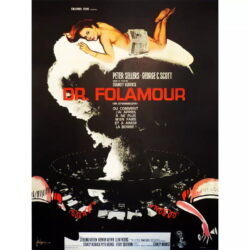


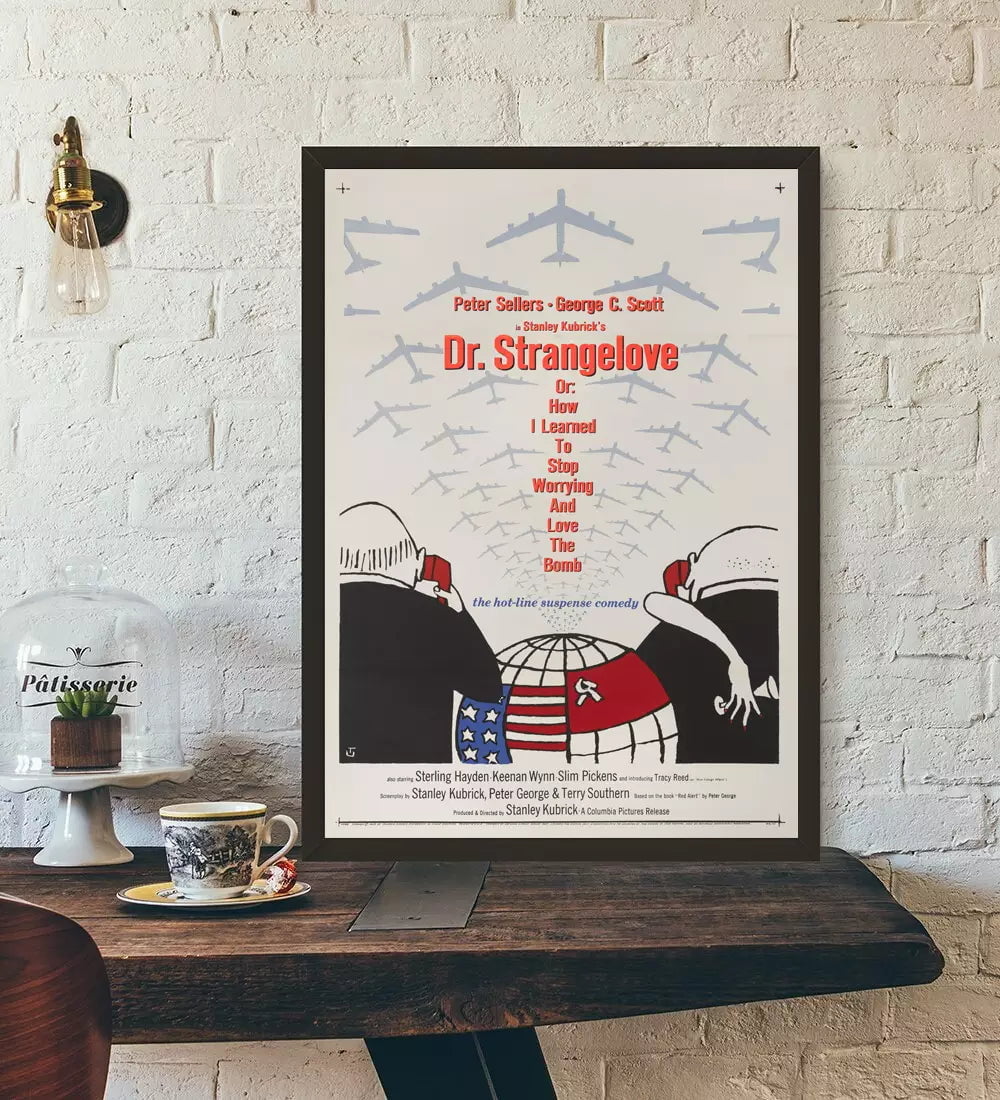
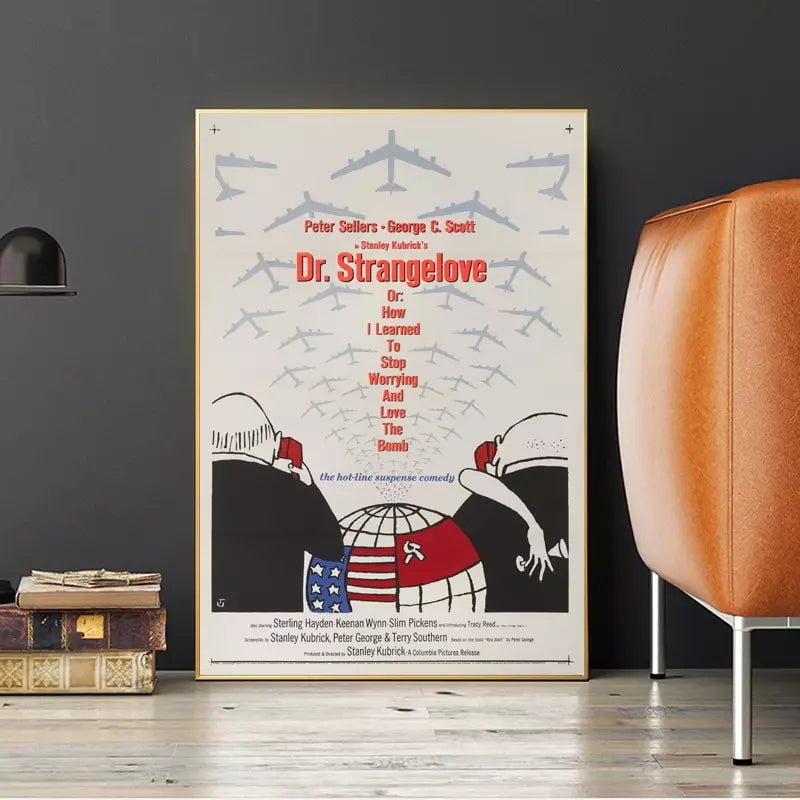


















Discover the Dr. Strangelove Poster, Stanley Kubrick’s cult classic about the Cold War and human madness. Delve into the absurdity of nuclear power with dark humor and a breathtaking performance by Peter Sellers.
- Paper Feature:
- 🎨 Canvas: Global standard in printing and imitating a “painting canvas” look.
- By default, the poster contains a 4cm white border for framing (frame not included). If you don’t want it, please choose “without white border”.
- ✅ Size: several choices available. ✅
- High UV resistance.
- Maximum color brilliance without reflections.
- Recycled paper guaranteed environmental friendliness.
- Poster wrapped carefully and delivered in a protective tube for total protection.
- FREE STANDARD DELIVERY.
⚠️ Frame not included. ⚠️
Description of this Dr. Strangelove Poster
Dr. Strangelove or: How I Learned to Stop Worrying and Love the Bomb, known simply and more commonly as Dr. Strangelove, is a 1964 satirical black comedy film that satirizes Cold War fears of nuclear conflict between the Soviet Union and the United States. The film was directed, produced, and co-written by Stanley Kubrick and stars Peter Sellers, George C. Scott, Sterling Hayden, and Slim Pickens. The film is loosely based on Peter George’s thriller novel Red Alert (1958).
The story concerns a raging U.S. Air Force general who orders a preemptive nuclear attack against the Soviet Union. It separately follows the President of the United States, his advisors, the Joint Chiefs of Staff, and a Royal Air Force exchange officer as they attempt to prevent the crew of a B-52 (who were following the general’s orders) from bombing the Soviet Union and starting a nuclear war.
The film is often considered one of the best comedies ever made, as well as one of the greatest films of all time. In 1998, the American Film Institute ranked it twenty-sixth on its list of the best American films (in the 2007 edition, the film ranked thirty-ninth), and in 2000, it was ranked number three on its list of the funniest American films. In 1989, the United States Library of Congress included Dr. Strangelove as one of the first 25 films selected for preservation in the National Film Registry for being “culturally, historically, or aesthetically significant.”
U.S. Air Force Brigadier General Jack D. Ripper is the commander of Burpelson Air Force Base, home to the 843rd Bomb Wing, flying B-52 bombers armed with hydrogen bombs. The planes are on airborne alert two hours from their targets inside the USSR.
General Ripper orders his executive officer, Group Captain Lionel Mandrake (a Royal Air Force exchange officer), to place the base on alert, confiscate all private radios of base personnel, and broadcast “Wing Attack Plan R” to patrolling bombers. All aircraft begin attack flights on the USSR and set their radios to allow communications only through their CRM 114 discriminators, which are designed to accept only communications preceded by a secret three-letter code known only to General Ripper. Occurring on a radio that had been missed earlier and hearing a normal civilian broadcast, Mandrake realizes that no attack order has been issued by the Pentagon and tries to arrest Ripper, who locks them both in his office. Ripper tells Mandrake that he believes the Soviets have fluoridated the American water supply to pollute Americans’ “precious bodily fluids.” Mandrake realizes that Ripper has gone mad.
In the Pentagon War Room, General Buck Turgidson briefs President Merkin Muffley and other officers on how “Plan R” allows a senior officer to launch a retaliatory nuclear attack against the Soviets if all superiors have been killed in a first strike on the United States. It would take two days to try every combination of CRM codes to issue a recall order, so Muffley orders the U.S. military to storm the base and arrest General Ripper. Turgidson, noting the slim chance of recalling the planes in time, then proposes that Muffley not only let the attack continue but send reinforcements. According to an unofficial study, this would result in “modest and acceptable civilian casualties” from the “badly damaged and uncoordinated” Soviet military remaining after the initial attack. Muffley refuses this plan and instead brings Soviet Ambassador Alexei de Sadeski into the war room to call Soviet Premier Dimitri Kissov on the “hotline.” Muffley warns the Prime Minister of the impending attack and offers to reveal the bombers’ targets, flight plans, and defensive systems so the Soviets can protect themselves. After a heated discussion with the Prime Minister, the Ambassador informs President Muffley that the Soviet Union has created a doomsday machine as a nuclear deterrent; it consists of numerous buried bombs jacketed with “cobalt-thorium G,” which are supposed to automatically detonate in the event of a nuclear attack on the country. The resulting nuclear fallout would then engulf the planet for 93 years, rendering the Earth’s surface uninhabitable. The device cannot be deactivated, as it is programmed to explode if such an attempt is made. The wheelchair-bound president’s scientific advisor, former German Nazi Dr. Strangelove, points out that such a doomsday machine would only be an effective deterrent if everyone knew about it; Alexei responds that the Soviet Premier had planned to reveal its existence to the world the following week at the party convention.
U.S. Army troops arrive at Burbelson and engage in combat with the garrison. After General Ripper commits suicide, Mandrake identifies Ripper’s CRM code from his office blotter and relays it to the Pentagon. Using the code, Strategic Air Command successfully recalls all but one of the bombers, commanded by Major T. J. “King” Kong, due to radio equipment being damaged in a missile attack. The Soviets attempt to find him, but Kong directs the bomber to attack a closer target due to dwindling fuel. As the plane approaches the new target, a Soviet ICBM site, the crew is unable to open the damaged bomb bay doors. Kong enters the bay and repairs the electrical wiring while riding an H-bomb, after which the doors open and the bomb is dropped. Kong hoots happily and waves his cowboy hat as he rides the bomb, which falls to his death. Back in the war room, Dr. Strangelove recommends that the President gather several hundred thousand people to live in deep underground mines where the radiation will not penetrate. He suggests a 10:1 female to male ratio for a breeding program to repopulate the Earth once the radiation subsides, a plan that garners enthusiastic support from the all-male command staff. Worried that the Soviets will do the same, Turgidson warns of a “mineshaft gap” while Alexei secretly photographs the war room. Dr. Strangelove declares he has a plan, then suddenly stands up from his wheelchair and exclaims, “Mein Führer, I can walk!” The film cuts to a montage of nuclear explosions, accompanied by Vera Lynn’s rendition of the song “We’ll Meet Again.”