


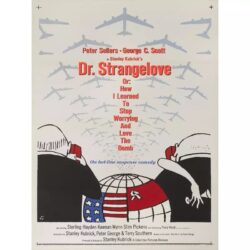



















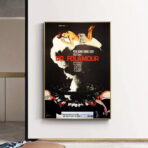














Discover the Dr. Strangelove Poster, Stanley Kubrick’s cult classic about the Cold War and human madness. Delve into the absurdity of nuclear power with dark humor and a breathtaking performance by Peter Sellers.
- Paper Feature:
- 🎨 Canvas: Global standard in printing and imitating a “painting canvas” look.
- By default, the poster contains a 4cm white border for framing (frame not included). If you don’t want it, please choose “without white border”.
- ✅ Size: several choices available. ✅
- High UV resistance.
- Maximum color brilliance without reflections.
- Recycled paper guaranteed environmental friendliness.
- Poster wrapped carefully and delivered in a protective tube for total protection.
- FREE STANDARD DELIVERY.
⚠️ Frame not included. ⚠️
Description of this Dr. Strangelove Poster
Dr. Strangelove or: How I Learned to Stop Worrying and Love the Bomb is a 1964 satirical film by Stanley Kubrick about the Cold War and nuclear deterrence. It is based on the novel Red Alert! by Peter George. In the United Kingdom and the United States, the film was released in cinemas on January 29, 1964, in the Federal Republic of Germany on April 10, 1964.
The film depicts how the insane U.S. Air Force General Jack D. Ripper tries to start a nuclear war against the Soviet Union by ordering B-52 bombers under his command to attack Burpelson Air Force Base. Ripper is convinced of a secret Soviet plan that he wants to forestall; The “precious bodily juices” of the American people should be decomposed, among other things, by fluoridating the drinking water. He had become aware of this “secret knowledge” when he felt profound exhaustion after intercourse.
He instructed his subordinates to defend the base under all circumstances, as “the Reds,” perhaps even disguised as American soldiers, could attack the base. Furthermore, to prevent the enemy from being deceived, he cut all telephone and data connections and had all radio equipment collected.
General Buck Turgidson informed US President Muffley of the situation during a crisis meeting in the Pentagon’s war room. The bombers were en route and could not be recalled because only Ripper knew the recall code, and it would take two days to try all options. The Soviet Union would certainly retaliate. Turgidson therefore suggests that the President use all available nuclear weapons against the Soviet Union in order to achieve complete victory. One could keep one’s own losses to an “acceptable” 10 to 20 million deaths, which could still be considered a success, compared to 150 million with hesitant action.
Muffley is horrified by this proposal. He does not want to “go down in history as the greatest mass murderer since Adolf Hitler.” So he brings the Soviet ambassador to the command center and contacts the Moscow Kremlin. The ambassador explains to those present that the Soviet Union has designed and activated a global extermination machine that would automatically and inexorably respond to a nuclear attack by destroying all life on Earth with nuclear fallout. Urgently, both governments are now using every means to bring the fatal situation under control.
President Muffley has the Air Force retake the base. Commander Jack D. Ripper shoots himself in the toilet because he’s afraid of revealing the recall code under the torture he fears. The British exchange officer, Group Captain Lionel Mandrake, still manages to learn the bombers’ recall code. After various difficulties, he finally manages to connect with the Pentagon and pass the code. Almost all the bombers then return. The Russians have fired three bombers in advance, while a plane nicknamed The Leper Colony (“The Lepra Colony”) under the command of Texan Major “King” Kong was only damaged by a nearby rocket explosion. The radio system was destroyed, preventing the crew from receiving the return command and continuing to fly.
The leper colony is losing fuel and cannot reach its primary or secondary objective (engaged in Soviet air defense against General Turgidson’s protest). After calculating the remaining range, the crew decided on one of the alternative targets specified in the application documents. Since the plane was flying so low that it could not be detected by enemy radar, Soviet air defenses were unable to intercept it. The leper colony therefore continued its attack—but now the bomb well could not be opened. Major Kong himself descended, climbed onto one of the two hydrogen bombs, where he managed to solve the problem: the flaps opened, and the bomb was dropped while he was still sitting on it. In a (later legendary) sequence, the Texas officer then fell toward the finish line—sitting astride the bomb, tipping his cowboy hat with a clap.
However, the now-foreseeable end of civilization only briefly dismayed the American headquarters. Dr. Strange, a wheelchair-bound German scientist currently working for the U.S. government, clearly explains how the survival of a small part of the American nation in the mining tunnels could still be ensured. To ensure military superiority even after the 100-year project, the scientist, who can barely keep his right arm from the Hitler salute, proposes a human breeding program that could include a polygynous community with ten women per man. An electronic brain would select the most efficient and genetically perfect participants. Of course, political and military leaders would have to be evacuated to the mines to maintain discipline and order. This prospect is very popular with the politicians and military personnel present. Dr. Strangely, suddenly gets up from his wheelchair and shouts, “My guide, I can go back!”
The final sequence shows – musically accompanied by the very popular British war hit We’ll Meet Again – the annihilation of human civilization by atomic bomb explosions.